Egypt’s Bent Pyramid Bends Because Builders Fixed It Twice
Its kink records two ancient engineering rescues that taught Egyptians how to build a true pyramid.
 National Geographic · Unearthing Egypt's Pyramids | Lost Treasures of Egypt MEGA Episode | National Geographic
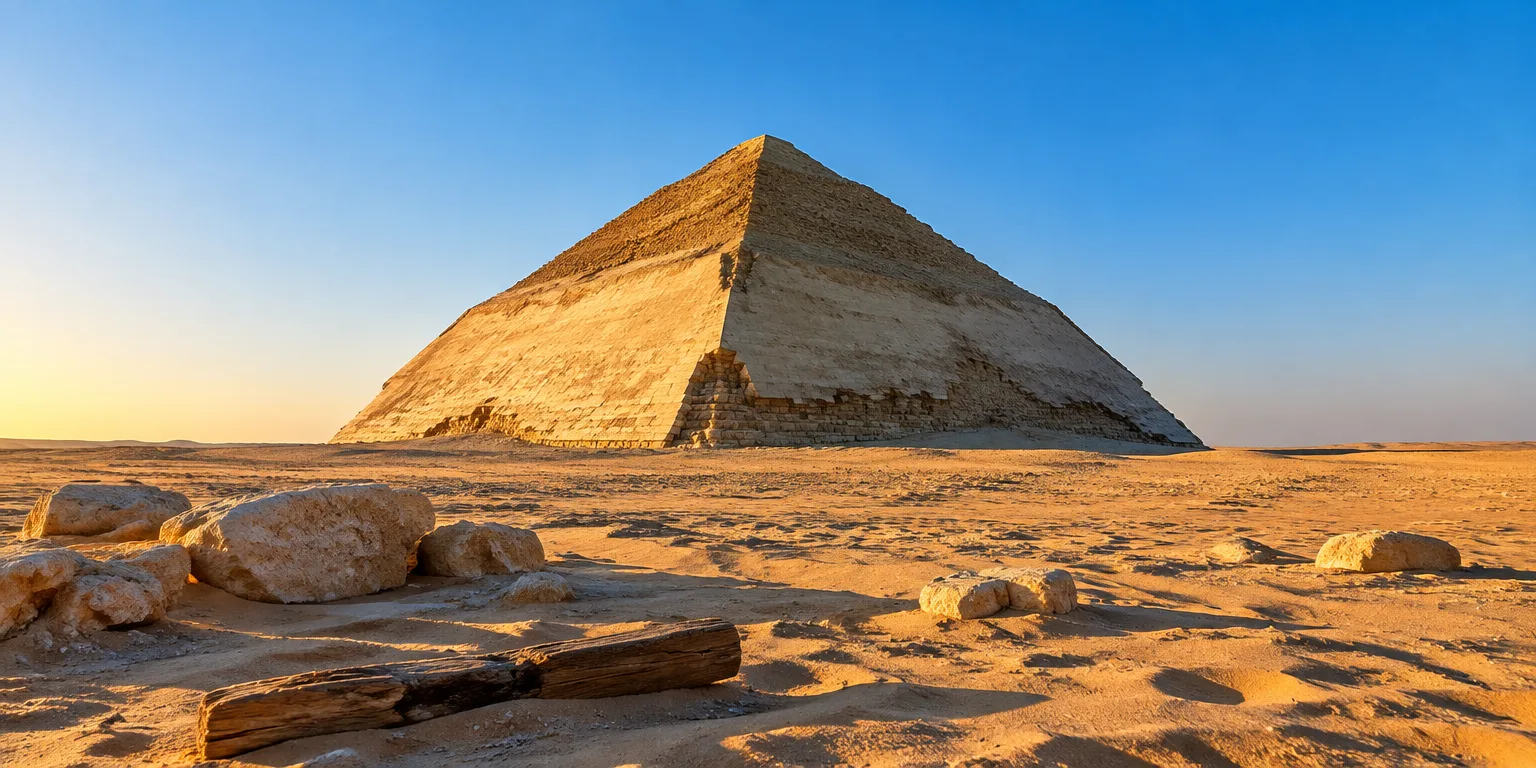
Look closely at Sneferu's Bent Pyramid and the kink is impossible to miss. It starts brutally steep, then well above the base, the slope suddenly turns shallow.
That bend was not the plan. It reflects two changes of plan made while the stones were still going up.
Pharaoh Sneferu ordered the tomb about 50 years after the stepped pyramid of Djoser, as an early experiment with a pyramid with smooth, unstepped sides.
Builders began very steeply. Archaeologist Dr. Chris Naunton describes the start as about 55 degrees, while the narration gives 60 degrees.
The enormous mass rested on weak soil, which may have caused movement that can still be seen.
In a steep passage, Naunton said, "the ceiling block looks as though it has slipped, maybe a foot."
In the burial chamber, he also found ancient cedar beams, wood thought to have been imported from Lebanon. The builders seem to have wedged them in to keep the weight of stone above from crushing the chamber and collapsing the whole structure inward.
To support the structure, they widened the base and continued upward at a shallower 54 degrees. Then, at roughly 45 meters up, problems returned.
To lighten the load, they flattened the top section to 43 degrees. The result is the bent profile seen today, steep below and squat above.
Despite the fixes, the building marked a historic first: a pyramid with smooth, unstepped sides. Naunton describes the work as trial and error by builders with no blueprint or template.
The lessons paid off nearby. Sneferu's follow-up, the Red Pyramid, is what Naunton calls "a true, straight-sided, geometric pyramid." Sneferu was likely buried there, while the Bent Pyramid lived on as the place where his cult was honored.
Questions people ask
Why did builders want smooth sides in the first place?
Before Sneferu, royal tombs like Djoser’s had stepped sides, built like stacked boxes. Smooth sides were harder to engineer, but they created one continuous triangular face rising to a point, the classic pyramid shape later perfected at Giza.
How big is the Bent Pyramid, and where is it?
The Bent Pyramid stands about 105 meters tall at Dahshur, south of Cairo, and its lower part still keeps much of its original pale limestone casing. That casing is why it looks better preserved than many later pyramids, which were stripped for stone.
Are those wooden beams really 4,500 years old?
They appear to be original construction timber, left in place for about 4,500 years in the dry desert interior. Cedar was prized in Egypt because native trees were small, so Egyptians imported tall cedar logs from Lebanon for boats, coffins, and major building work.