Trash Heaps Hid a New Part of King Sahure's Temple
A 4,400-year-old pot of red paint matched graffiti on a buried wall, confirming the structure was original.
 National Geographic · Unearthing Egypt's Pyramids | Lost Treasures of Egypt MEGA Episode | National Geographic
At Abusir, archaeologist Mohamed Khaled has uncovered a previously unrecorded part of King Sahure's funerary temple, hidden beneath 20-foot-deep spoil heaps left by a 1907 excavation.
The find matters because Sahure's complex became the template for later royal monuments, so a new wall revises the understood layout of a 4,400-year-old sacred site.
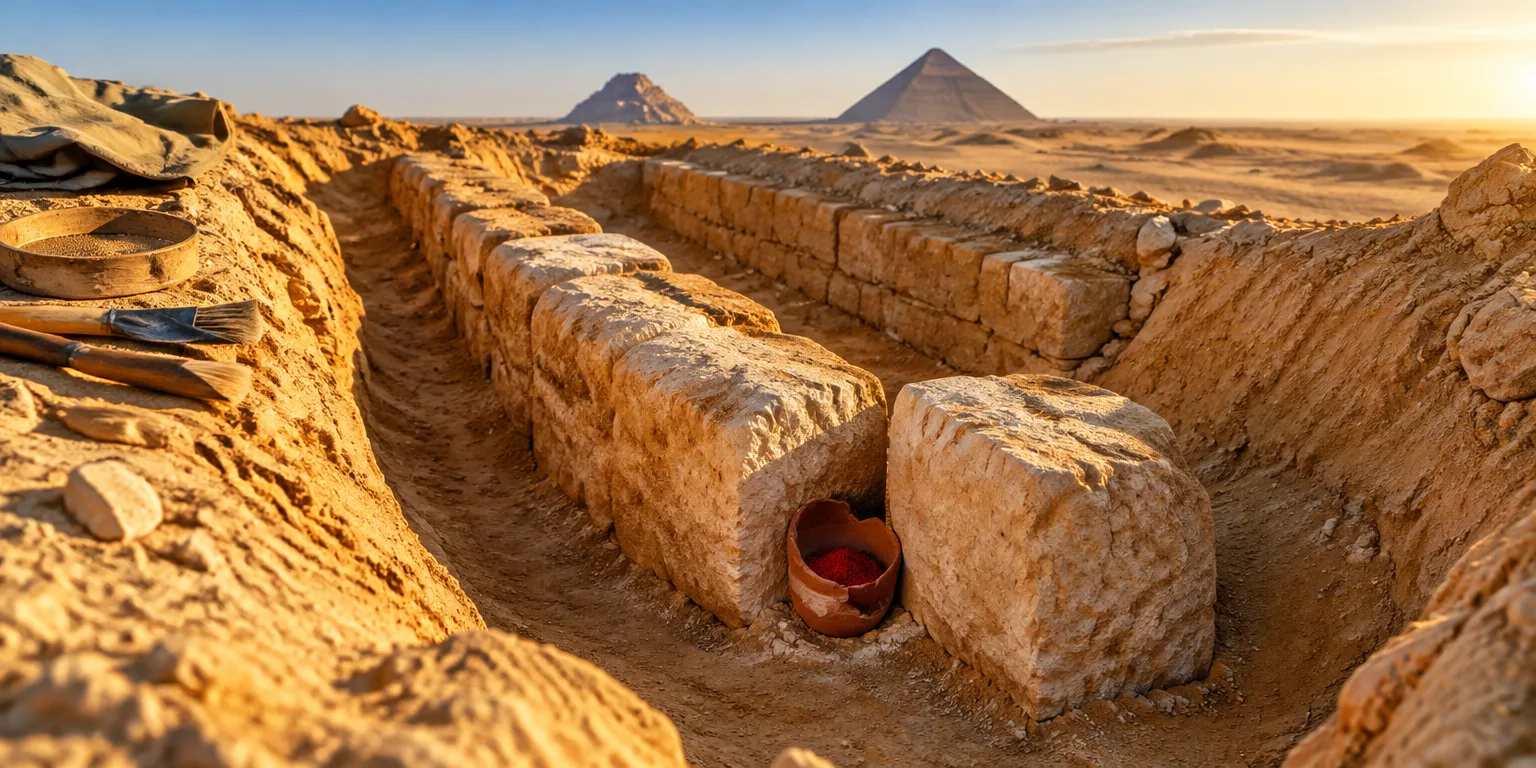
Khaled, who has studied Sahure's collapsed pyramid for more than 20 years, reasoned that the 1907 team had dumped debris to the sides without checking what lay underneath. After his crew moved tons of sand over two days, they exposed stone blocks in untouched ground.
Between the blocks, they found part of a broken clay container holding red powder, preserved for more than four millennia. Khaled said such paint was used for masonry marks that instructed workers, though he cautioned that the broken pot could have been moved and dumped there.
A layer deeper settled the question. Hieroglyphic graffiti on the stonework matched the pot's pigment in color, and the foundation stones were set into bedrock, showing the structure was original and part of the funerary temple.
Nearby, the team found a second, parallel wall aligned with the first. Khaled thinks the pair may form a limestone avenue, possibly the priests' side entrance, separate from the central sacred causeway reserved for the king. He plans to trace whether the wall extends toward the pyramid.
Questions people ask
Who was King Sahure?
Sahure was the second king of Egypt's Fifth Dynasty, usually put around 2490 to 2475 B.C., part of a line sometimes called the Sun Kings for their devotion to the sun god Ra. He built a navy, sent trading expeditions for frankincense and myrrh, and raised a roughly 150-foot pyramid at Abusir.
What is a funerary temple?
A funerary temple stood beside a king's pyramid and was where subjects honored the dead ruler. That is different from a sun temple, which was dedicated to worship of the sun god Ra. In Sahure's case, priests performed rites in his name for about 200 years after his death.
Why would archaeologists dig through another excavation's trash?
A spoil heap is the pile of sand and rubble left beside an excavation after archaeologists remove it from a dig. Older expeditions sometimes moved earth quickly without screening it fully, so later teams can find missed walls, pottery, and other clues underneath or inside the dumps.