Stacked Transistors Could Double Chip Density If The Heat Can Escape
Memory chips already rise in tall stacks, but processor logic burns too much power to pile up without cooking itself.
 Dwarkesh Podcast · What will computer chips look like in 2045?
One way to put twice as many transistors on a chip may be to stop spreading them out and start piling them up.
Nearly every circuit pairs two kinds of transistor switches that work the same way with opposite electrical charges, known as n-type and p-type. Today those partners sit side by side, but stacked one atop the other they could fit about twice as much computing into the same patch of silicon.
That stacked design goes by the initials CFET, for complementary field effect transistor. Intel process-development leader Chris Oth says newer building blocks make it easier to imagine.
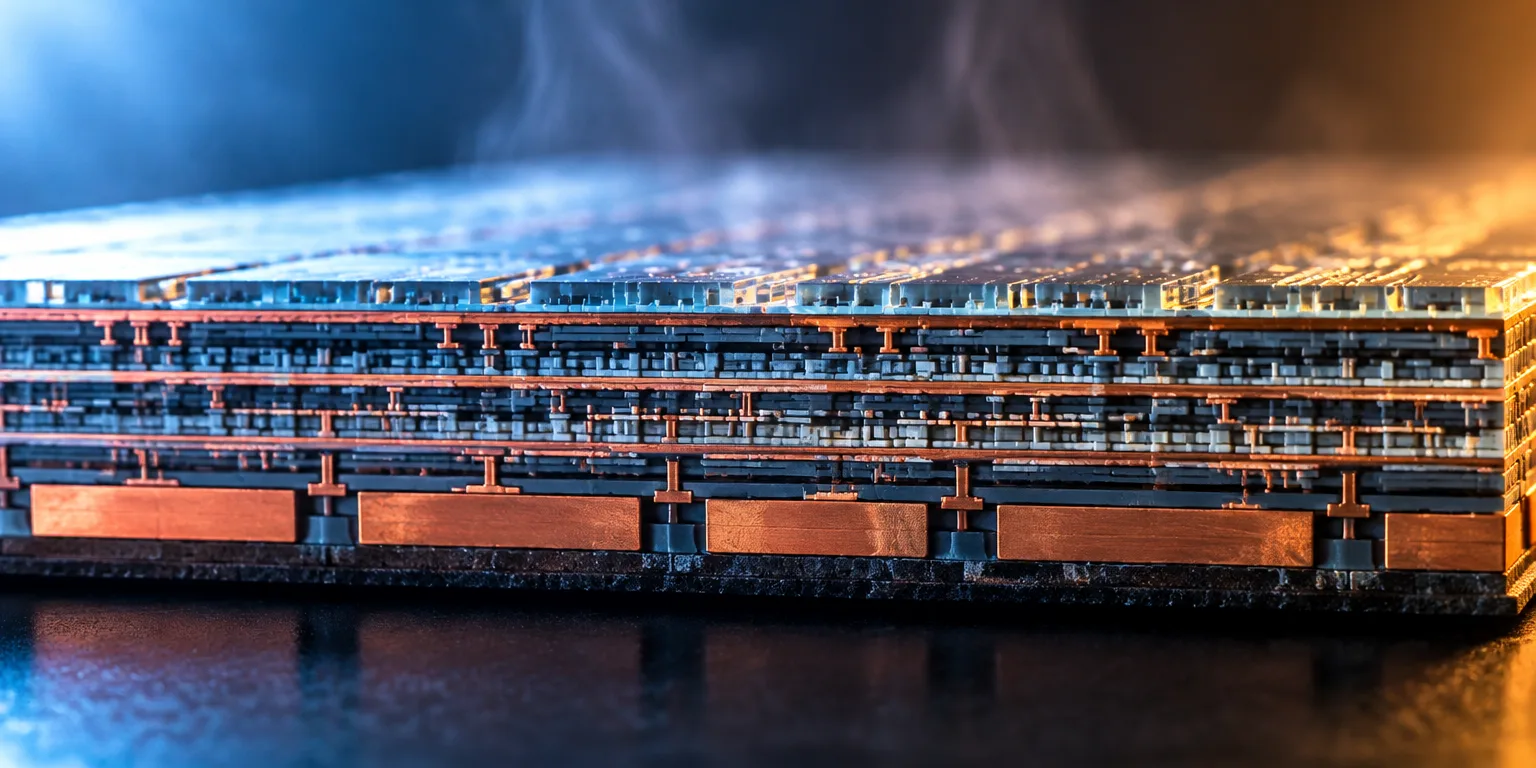
With backside power, thick power lines run under the transistors, leaving more room above for signals. Transistors then sit surrounded by wiring, so engineers can picture alternating layers of transistors and wiring rising upward.
Memory chips already look like that. The flash memory in phones, known as NAND, is built as a tall stack, and other memory is headed the same way.
Logic is harder because processors use far more power than memory. The chips that do calculations switch constantly, so every extra layer also adds heat with no clear way to escape.
Oth puts compute down to three related limits: how fast a transistor can switch, how much power each switch needs, and how to remove the heat that switch creates.
That is why thermal design may decide the future of denser chips. Oth says the system-level modeling and simulation tools needed to predict heat in such three-dimensional devices are still in their infancy, and managing temperature will remain a limiter even as stacking becomes possible.
Questions people ask
How tall are memory stacks today?
NAND flash stores data in vertical towers with more than 200 layers in current products, which lets capacity grow without shrinking each cell. 3D DRAM and high-bandwidth memory also stack layers or chips, but they switch less often and use less power than logic, so they make less heat per volume.
How do chips get rid of heat now?
A high-end processor can dissipate more than 100 watts across a fingernail-size die, with concentrated hot spots that exceed 100 degrees Celsius. Computers handle it with metal heat spreaders, fans, liquid cooling, and by slowing the chip when sensors report overheating.
What is backside power?
Traditionally power and signals shared the wiring above the transistors, crowding the chip. Backside power moves thick power lines beneath the transistors, leaving more room above for signals and making it easier to feed stacked devices.