The Smartest Animals Stay Helpless the Longest
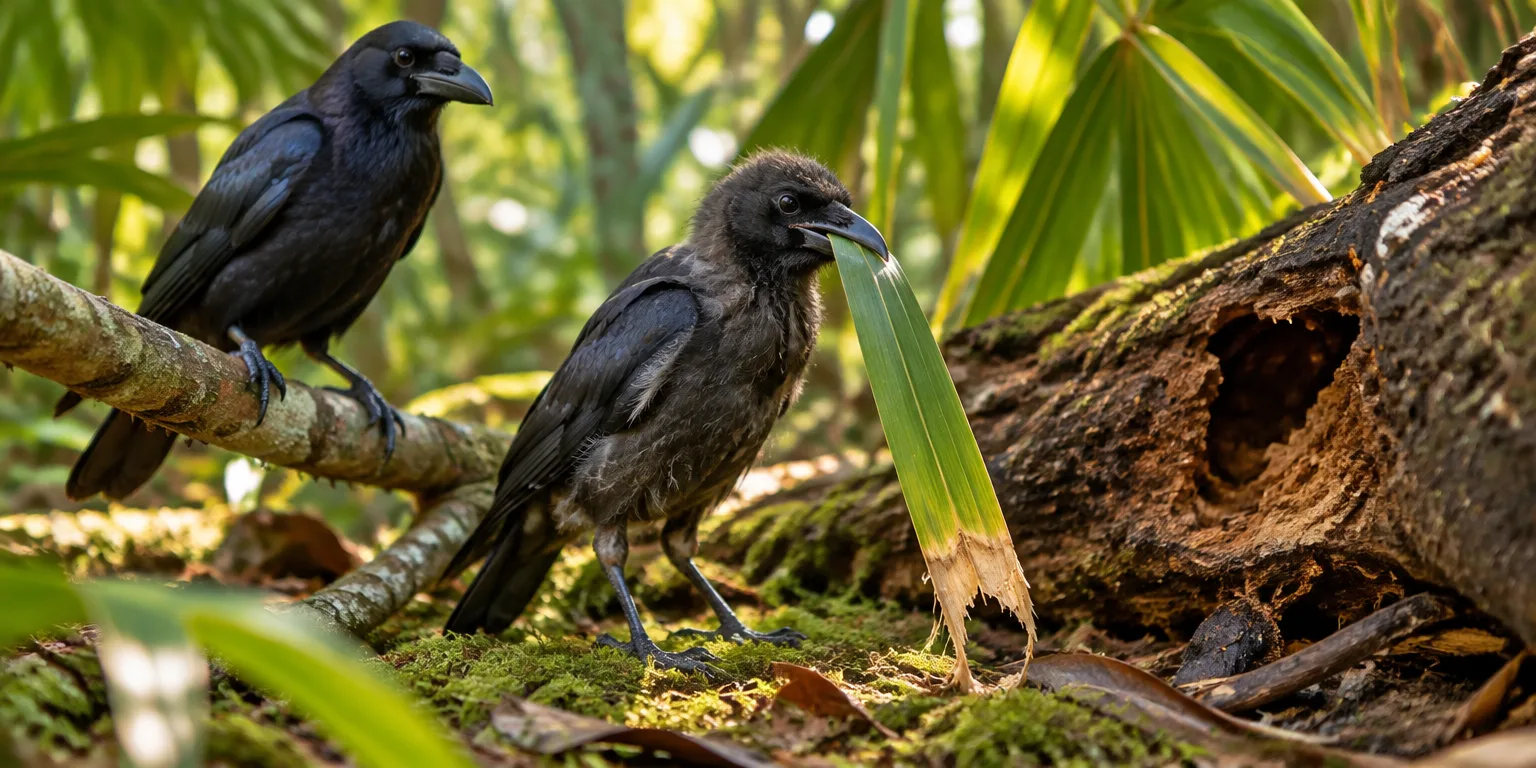
Two years of failed toolmaking is how young crows are thought to learn to handle new places.
 Talks at Google · The Gardener and the Carpenter | Alison Gopnik | Talks at Google
In a 2016 talk, Alison Gopnik, a psychologist who studies how children learn, described a pattern across many species: longer childhoods go with more flexible adults. By smart she meant flexible, good at learning to handle something new, not knowing more from birth.
Her poster birds were New Caledonian crows, forest birds that make and use tools. They remain fledglings for two years, still being fed by adults while they produce nothing themselves. That long dependence goes with unusual ability: one crow in a laboratory learned to bend a wire to fish food from a tube, and Gopnik said you can place one in a lab in Cambridge and it can figure out how to cope.
In the wild, the birds make tools from the leaves of pandanus palms. They strip off the lower leaves to leave sharp little hooks, chew one tip narrow, hold the broad end in the beak, probe a termite-filled cavity, and pull it out with termites stuck to the barbs.
Watch the young birds during those two years, Gopnik said, and what you see is failure. They start with the wrong side of the leaf, or poke with the blunt tip rather than the pointed one. Mothers sit nearby and drop termites into their mouths while they practice.
Gopnik's explanation for the pattern is that protected failure. A young animal that does not have to feed itself can try many possible behaviors, fail safely, and learn how to handle a new place before it has to survive in it. As a metaphor, she calls children the research and development division of the human species, while adults handle production and marketing.
Domestic chickens show the opposite deal. They mature within weeks or months. Newborn chicks perform elaborate computations that make them excellent grain peckers from birth, but those programs are already in place. They do from day one what they will always do, rather than learning new skills for a changed environment.
A mammal pair shows the same contrast, in her account. Quokkas, small fuzzy marsupials in Australia, keep one baby in the mother's pouch for up to a year, with mothers, fathers, and even unrelated animals helping. Virginia possums raise litters of seven or eight at once, leave care to the mother alone, and the young mature in just a few months.
Gopnik said her friends in comparative psychology tell her that possums are strikingly poor learners. As one example, she noted that the possum brain is half the size of the quokka brain though the animals are about the same body size.
Humans, Gopnik said, are far out on the quokka end of the spectrum. We usually raise a single infant at once, stay immature for much longer, and have more caregivers involved with infants than any other animal. That long helplessness is expensive, and what it is thought to buy is flexibility.
Questions people ask
Does that mean chickens cannot do anything smart?
No. Newborn chicks perform elaborate computations that make them excellent at pecking for grain, which is harder than it looks. What they lack is open-ended learning, the ability to pick up entirely new skills when the surroundings change.
Is a bigger brain the reason longer childhoods produce smarter adults?
No. The source describes a correlation between longer childhood and more flexible adult learning, plus a correlation between greater adult investment and intelligence. The quokka and possum brain difference is presented as one example in marsupials, not proof that brain size causes the pattern or that it holds in the same form everywhere.
Why would failing for two years be useful?
Trying many approaches and failing is how young animals discover what works in an unpredictable place. Gopnik notes that slogans about failing faster capture the same logic. Childhood provides a protected period to do that failing before mistakes become costly.