Wired TVs Leave More Wi-Fi for Your Phone
Wi-Fi is shared airtime, so stationary screens that use cable stop competing with the phones and laptops that must stay wireless.
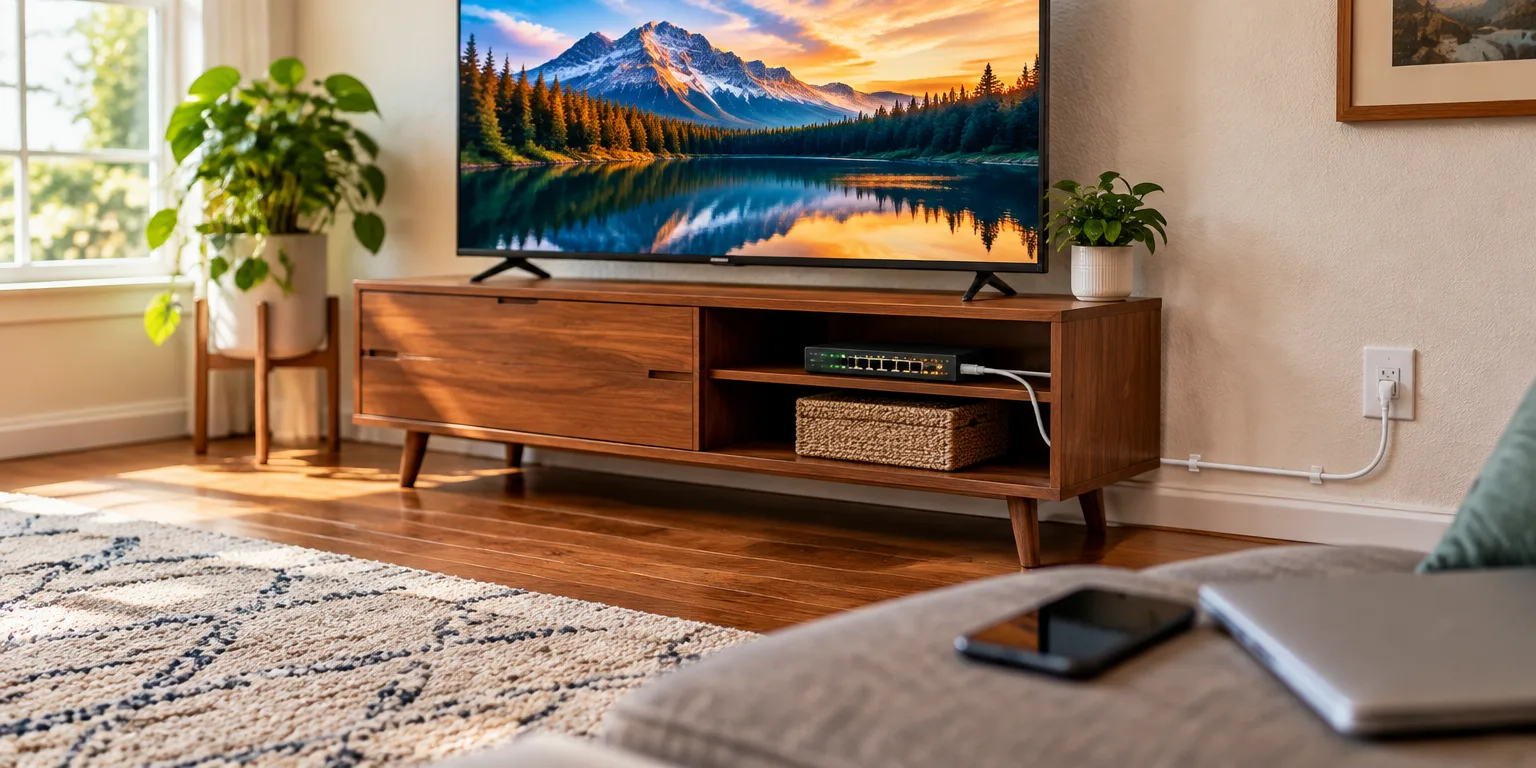
One of the most overlooked parts of a home network involves devices that stop using Wi-Fi at all. Televisions, game consoles, desktop computers, printers, and storage drives that sit in one place can connect by cable instead.
That matters because Wi-Fi is shared airtime. Wireless devices in a home compete for turns to talk, so phones and laptops that move around must wait while stationary screens use the same airwaves.
A device that connects by cable leaves that competition. It sends its traffic through its own wired path, which is faster and more reliable, and it leaves more wireless turns for the devices that remain.
One wall connection can serve several nearby devices through equipment called a switch. Behind a living room television, for example, one wired path can serve that whole entertainment corner at once.
Where cable through walls is not present, network signals sometimes travel over wiring already in the walls. One method uses existing coaxial television cabling, while another method uses household electrical wiring.
The result is less wireless congestion. The devices that move get quieter airwaves because the devices that never move are no longer in them.
Questions people ask
What does Wi-Fi airtime actually mean?
Wi-Fi devices in the same area share the same radio channels, so only one can transmit at a time. Each transmission takes a turn, and other devices wait. When fewer devices compete, each waiting device gets its turn sooner.
Why is a cable connection steadier than Wi-Fi?
A cable gives connected devices a private path that does not share airwaves with nearby wireless traffic. It is also less affected by distance, walls, and interference from household electronics. Traffic still shares the internet connection, but not the wireless channel.
How does internet travel over old TV cables?
Coaxial cables once installed for television can also carry network signals with adapters at each end. The signals travel through the shielded cable between rooms. That creates a wired style link where no new Ethernet cable has been run.