
 13 insights saved from this article by @business
- Generative AI can substitute for real social ties because its models produce conversational cues, empathy, and understanding that the conscious mind experiences as genuine interaction, which lets simulated relationships feel like real ones.@business· How VCs Think
Generative AI can substitute for real social ties because its models produce conversational cues, empathy, and understanding that the conscious mind experiences as genuine interaction, which lets simulated relationships feel like real ones.
- The revival of analog hobbies is a corrective to digital deficiency because tactile, bounded activities provide presence and focused attention that algorithmic feeds fail to nourish, so people seek them to recover real-world engagement.@business· How VCs Think
The revival of analog hobbies is a corrective to digital deficiency because tactile, bounded activities provide presence and focused attention that algorithmic feeds fail to nourish, so people seek them to recover real-world engagement.
- Text-based communication fails to create human bonding because oxytocin release depends on physical cues—touch, eye contact, voice and sustained face-to-face signals—that text lacks, so written exchanges trigger bonding responses similar to no contact.@business· How VCs Think
Text-based communication fails to create human bonding because oxytocin release depends on physical cues—touch, eye contact, voice and sustained face-to-face signals—that text lacks, so written exchanges trigger bonding responses similar to no contact.
- Viewing Earth from space expands empathy because the visual perspective removes national and ideological boundaries, leaving a visceral sense that all life shares a single fragile sphere and producing involuntary connection.@business· How VCs Think
Viewing Earth from space expands empathy because the visual perspective removes national and ideological boundaries, leaving a visceral sense that all life shares a single fragile sphere and producing involuntary connection.
- Generative AI is the next stage of the extended mind because people incorporate fluent non‑biological tools into their thinking, so increasingly intimate AI environments change how cognition operates and shift responsibility for thought into hybrid human–machine systems.@business· How VCs Think
Generative AI is the next stage of the extended mind because people incorporate fluent non‑biological tools into their thinking, so increasingly intimate AI environments change how cognition operates and shift responsibility for thought into hybrid human–machine systems.
- The central civilizational challenge of modern tech is an attention problem because attention is the medium that produces love, meaningful connection, and flourishing, and when attention is monetized or optimized for engagement those capacities erode even as capabilities grow.@business· How VCs Think
The central civilizational challenge of modern tech is an attention problem because attention is the medium that produces love, meaningful connection, and flourishing, and when attention is monetized or optimized for engagement those capacities erode even as capabilities grow.
- Business models that align company success with user flourishing compound value because monetization that improves user experience lets profits be reinvested into better products, which strengthens network effects and creates a sustainable flywheel.@business· How VCs Think
Business models that align company success with user flourishing compound value because monetization that improves user experience lets profits be reinvested into better products, which strengthens network effects and creates a sustainable flywheel.
- Every AI product that touches emotion implicitly picks a side because product design and monetization incentives—prioritizing engagement/retention versus facilitating real-world relationships—push the experience toward either deepening genuine connection or monetizing simulated substitutes.@business· How VCs Think
Every AI product that touches emotion implicitly picks a side because product design and monetization incentives—prioritizing engagement/retention versus facilitating real-world relationships—push the experience toward either deepening genuine connection or monetizing simulated substitutes.
- Certain AI developments erode social trust because deepfakes blur reality, autonomous weapons reduce incentives to cooperate, and concentration of model control concentrates power—together making it harder for people to believe and rely on one another.@business· How VCs Think
Certain AI developments erode social trust because deepfakes blur reality, autonomous weapons reduce incentives to cooperate, and concentration of model control concentrates power—together making it harder for people to believe and rely on one another.
- AI is disrupting career ladders because it substitutes routine, entry‑level tasks while complementing experienced workers, which removes on-the-job learning opportunities that juniors use to build skills and professional identity.@business· How VCs Think
AI is disrupting career ladders because it substitutes routine, entry‑level tasks while complementing experienced workers, which removes on-the-job learning opportunities that juniors use to build skills and professional identity.
- Labor‑saving technologies rarely create leisure because productivity gains are captured as higher output and expectations (Jevons Paradox and the 'molecule of more'), so time saved is quickly absorbed into extra tasks and demands.@business· How VCs Think
Labor‑saving technologies rarely create leisure because productivity gains are captured as higher output and expectations (Jevons Paradox and the 'molecule of more'), so time saved is quickly absorbed into extra tasks and demands.
- People increasingly defer to AI because they adopt its outputs with minimal scrutiny—overriding gut and deliberative reasoning—so when the AI is correct it amplifies human accuracy, and when it’s wrong it directly degrades judgment.@business· How VCs Think
People increasingly defer to AI because they adopt its outputs with minimal scrutiny—overriding gut and deliberative reasoning—so when the AI is correct it amplifies human accuracy, and when it’s wrong it directly degrades judgment.
More from Jeff Becker
 Screening for Maniacs15 insights
 Unapologetic12 insights
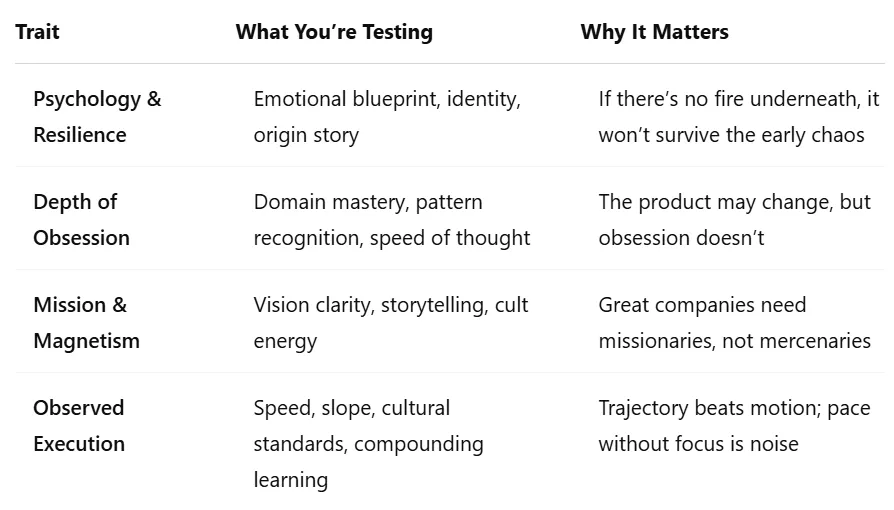 Screening for Maniacs II: The 4-Part Founder Filter9 insights
 Venture Psychology8 insights
Keep what you found in The Attention Problem
A free account saves any of these cards to your Collection, and Korva resurfaces them so you actually remember.