Korva is a scroll of the internet’s best ideas.

Watch founders, don't ask them
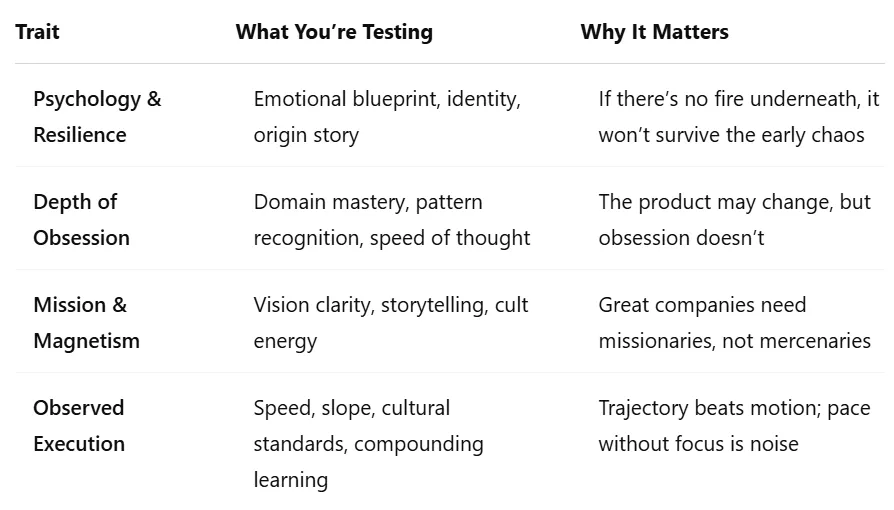
Trajectory, not talk
Interviews miss this part, and so do most early stage investors. What counts is trajectory, which means velocity in a direction. Raw speed alone doesn't show it.
The picture comes from a handful of things to watch. How fast does the founder build, iterate, and ship? What do they prioritize, and what do they ignore? Are they better week over week? Do other people follow them, and are they setting a cultural bar? Can they compress time?
Slope and intercept
Together these show slope and y-intercept: where someone starts, and how steeply they climb. Slope is how quickly a person processes input and gets better.
Small habits compound
Much of it appears in small places. How a founder texts, emails, and shares updates shows their urgency, and what they choose to work on first shows their priorities. Each of those habits compounds over time.
That is why a founder can fake polish in a conversation but cannot fake a steep slope over weeks of behavior.
Why do interviews predict performance poorly?
A 1998 meta-analysis by Frank Schmidt and John Hunter compared many hiring methods against later job performance. Work sample tests, where candidates do a piece of the real job, predicted performance better than unstructured interviews. Interviewers tend to form impressions from likability and confidence, which are easy to display in a conversation. A work sample produces evidence of the actual output.
Can small behaviors really reveal so much?
In 1992, psychologists Nalini Ambady and Robert Rosenthal showed people silent clips of teachers lasting only a few seconds. The ratings viewers gave from those clips closely matched the ratings students gave the same teachers after a full semester. The researchers called this thin slicing. Brief samples of ordinary behavior carry more information than people expect.
Why does the starting point matter less over time?
Growth that builds on itself outruns a head start. A line with a steeper slope eventually crosses any flatter line, whatever its intercept. Compound interest follows the same logic: a small rate applied repeatedly overtakes a larger sum that earns nothing. Mathematicians describe the crossing point as the place where the two lines have equal value.
More from Jeff Becker