Korva is a scroll of the internet’s best ideas.

Why will the 20th person join?
Why early hiring is hard
Early employees get worse pay and often meaningless equity, yet building a world-class team is crucial to a startup's success. A founder has to give people a reason to join that money can't supply.
What the question tests
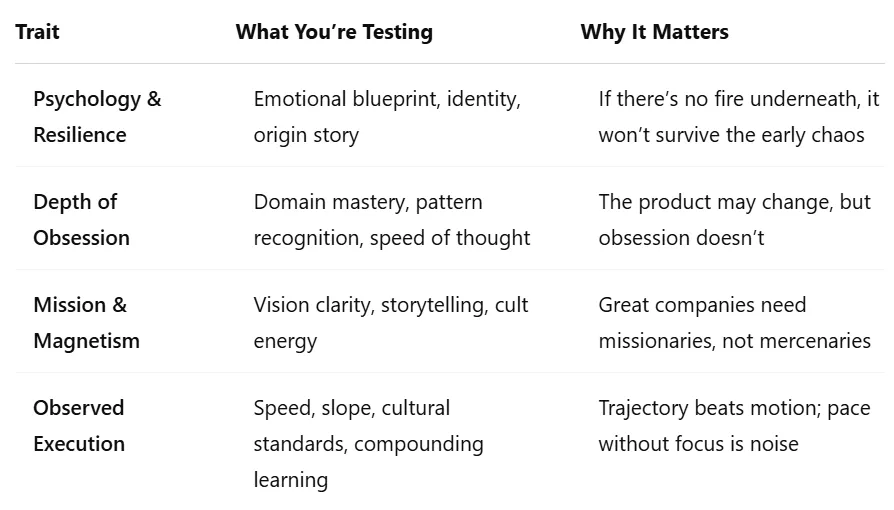
The question separates people playing at being a founder from those with a lifestyle business and those doing their life's work. The strong answer has a compelling vision, founder-led storytelling, transformation language, and clarity of purpose.
The weak answer
The weak answer is a vague narrative with little emotional resonance, or one that leans mostly on compensation.
Why does belief draw people when pay can't?
Self-determination theory, developed by psychologists Edward Deci and Richard Ryan, separates motivation that comes from within from motivation that comes from rewards. Their research found that people working on something they find meaningful put in more effort and stay with it longer. Teresa Amabile's creativity research at Harvard reached a similar finding about intrinsic motivation. A mission can supply that inner reason where a paycheck cannot.
What did Thiel write about early teams?
Peter Thiel's 2014 book Zero to One devotes a chapter to building a founding team. He argues that a startup is a small group of people bound by a shared mission, and that people who join early should be there because they want to work on the specific problem. He also stresses that the first hires set the culture that later hires inherit. The book grew out of lecture notes from his 2012 Stanford course on startups.
Why is early equity so uncertain?
Most startups never reach a sale or public offering, so most early equity never turns into cash. Venture capital returns follow a power law, where a few companies produce most of the gains and the majority return little or nothing. Even in successful companies, later funding rounds dilute the share of early holders. The value of an early grant depends almost entirely on the company's final outcome.
More from Jeff Becker