Korva is a scroll of the internet’s best ideas.
Writing began as ration receipts
Clay and Reeds
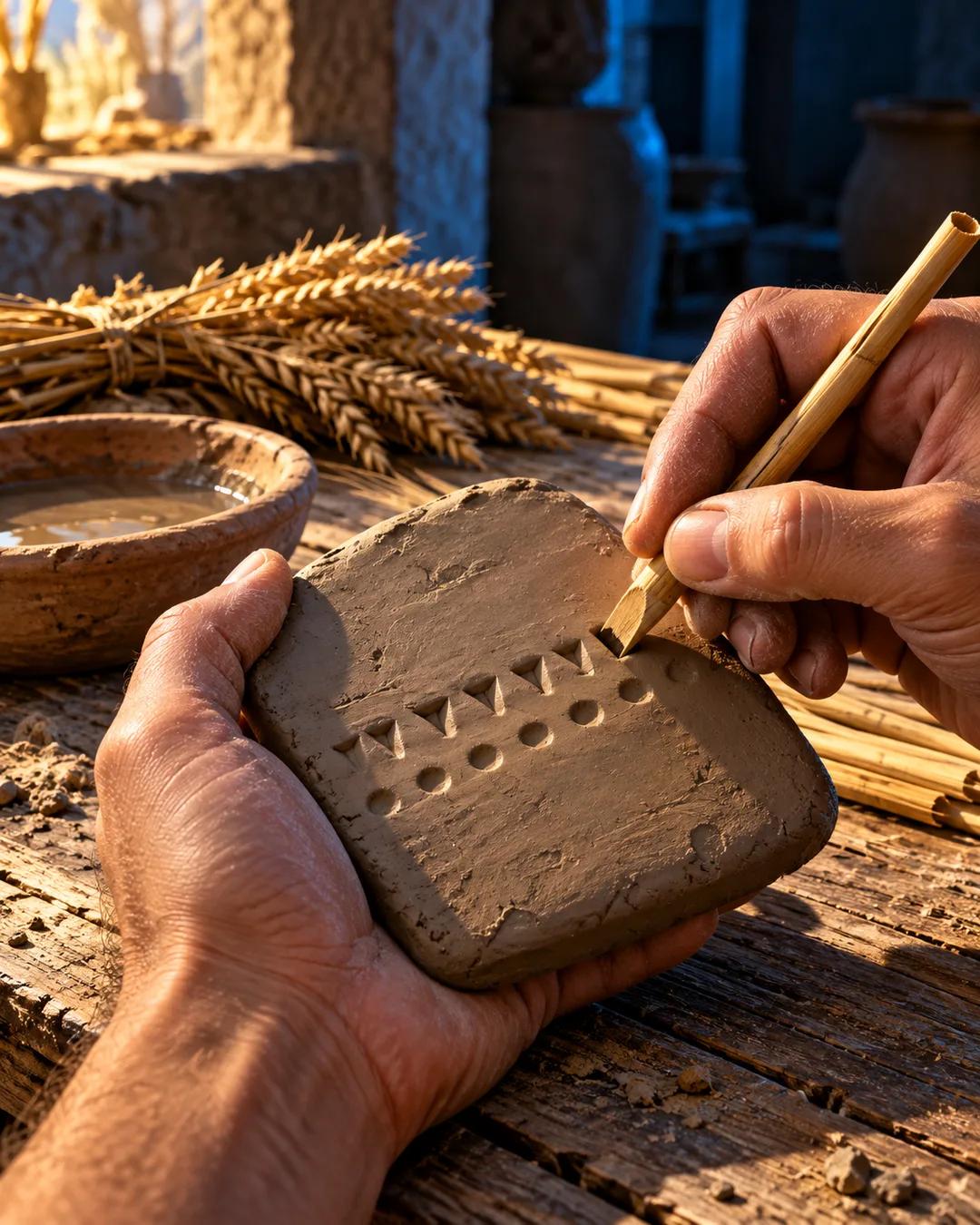
The Sumerians had two things in endless supply: clay under their feet and reeds growing in the marshes and along the riverbanks. A scribe held a lump of clay about the size of a modern smartphone, cut a reed into a wedge shape, and pressed it into the clay again and again to form symbols. Those wedges give cuneiform its name.
Tracking Rations
The oldest tablets come from Uruk, in the late fourth millennium BC, and they began as small pictures used to track rations and supplies. On one very early tablet, a bowl of food drawn with a mouth sits beside six marks and five bundles of wheat. That meant a worker could trade the tablet for six food containers and five sheaves of wheat.
Signs Become Sounds
Scribes copied hundreds of tablets in a day, and the hurry wore the pictures down into simpler, more abstract signs. After the year 3000 BC, the number of symbols dropped from about 1,500 to about 600, and someone had the idea that a symbol could stand for a sound instead of a whole idea.
A Sumerian poem about King Enmerkar tells its own version of how writing began: a king sends his messenger with so many messages that the messenger's heavy mouth cannot repeat them all, so the king presses words into clay. A separate class of scribes soon emerged, and people could read the words of kings and scribes who had died hundreds of years earlier.
How can a drawing stand for a sound?
Scribes used the rebus principle, where a picture stands for the sound of its word rather than its meaning. The Sumerian word for arrow, ti, sounded like the word for life, so the arrow sign could be used to write both. Spelling by sound later let scribes write personal names and foreign languages such as Akkadian with the same signs.
How did children learn to write cuneiform?
Schools were called tablet houses, and students spent years copying lists of signs, words, and model texts onto practice tablets. Teachers set the examples and students pressed their own versions beside them. Excavations of houses at Nippur turned up many hundreds of student exercise tablets.
Why have so many clay tablets survived?
Clay does not rot the way papyrus and parchment do. When a city burned, the fire often baked its unfired tablets as hard as pottery. The royal library of Ashurbanipal at Nineveh was destroyed in 612 BC, and tens of thousands of its tablets and fragments were later recovered.
More from Fall of Civilizations