A Breathable Coating Vastly Boosts Ethylene Made From Carbon Dioxide
The gain came not from a new catalyst, but from keeping carbon dioxide in and excess water out.
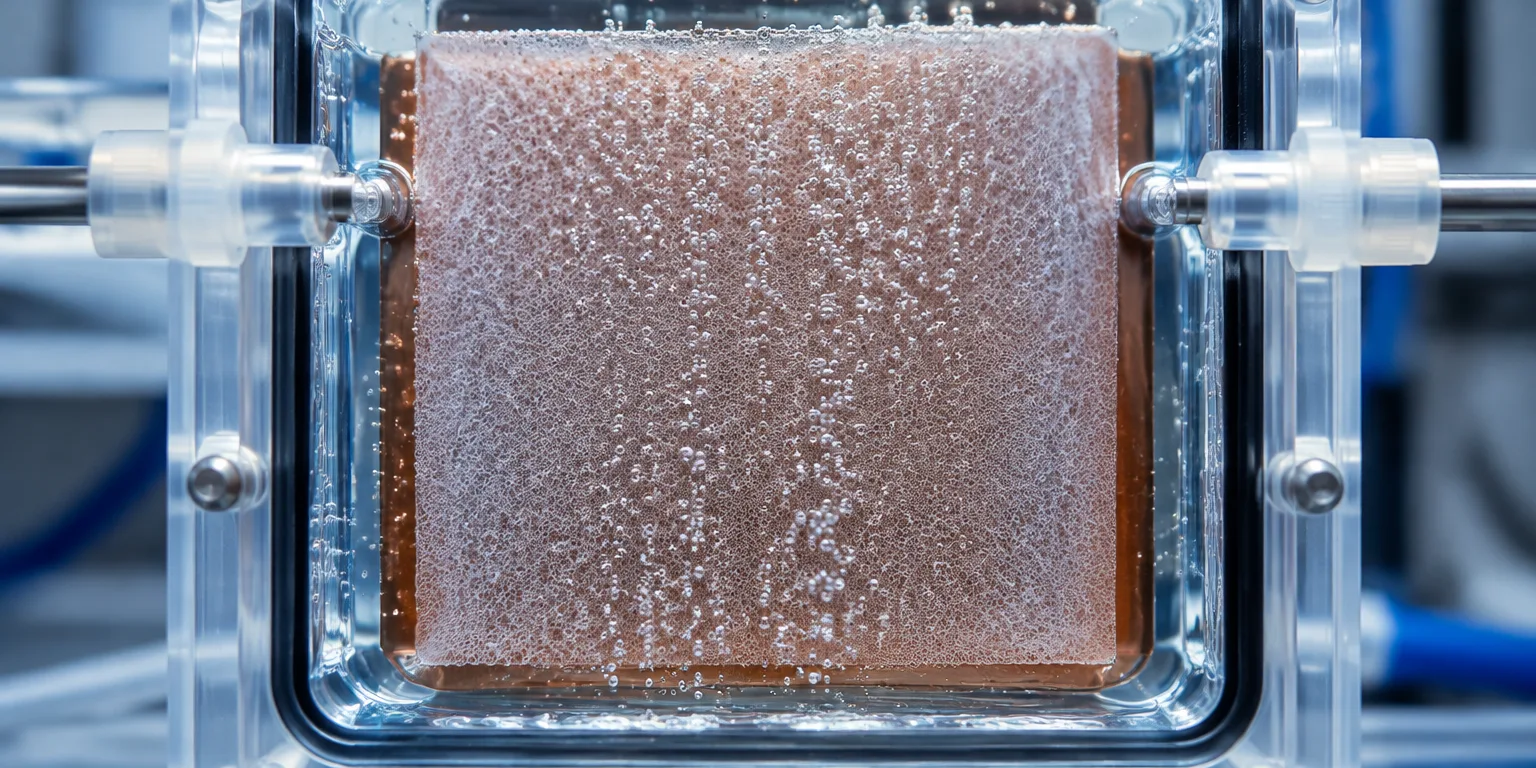
 digitalcommons.mtu.edu · "Mechanically stabilized porous aerophilicity unlocks ampere-rate trans" by Ahmed Badreldin, Lanxin Guo et al.
Researchers at Michigan Technological University reported on November 15, 2026 that they sharply boosted production of ethylene from carbon dioxide by changing the coating around a simple copper-based catalyst.
The result matters because ethylene, the building block for the world's most common plastic, is now made from fossil fuels, and a fast electric route could one day turn waste gas into useful chemical feedstock.
With a conventional PFSA coating, a standard polymer used to hold catalysts together and carry charged particles, the system made ethylene at 135 milliamps per square centimeter, a measure of production speed, at about 27 percent efficiency.
With a porous coating made from FEP and PTFE, water repelling plastics that let gas pass easily, plus a gentle heat treatment to stabilize it, output rose to more than 650 milliamps per square centimeter at about 65 percent efficiency. That efficiency means about two thirds of the electric current went to making ethylene.
The key was managing gas and liquid where gas, liquid, and solid catalyst meet. The new layer stayed open and sturdy, keeping carbon dioxide near the catalyst and limiting flooding by excess water.
Microscopy and spectroscopy showed how the polymer layer consolidated and bonded closely to the catalyst, while computer modeling linked the gains to better carbon dioxide availability and less flooding, rather than faster catalyst chemistry.
The authors say the same design approach could be useful beyond this one catalyst, for other fast reactions that use electricity to turn gases into chemicals.
Questions people ask
What do the speed and efficiency numbers mean?
Partial current density, measured in milliamps per square centimeter, is production speed for one product. Faradaic efficiency is the share of electric current that makes that product, with the rest lost to side reactions such as making hydrogen from water.
What is ethylene and why make it from carbon dioxide?
Ethylene is a gas used to make polyethylene, the plastic in bags, bottles, and packaging, plus other chemicals. Making it from carbon dioxide and electricity, rather than oil and gas, could cut emissions if the process becomes fast, selective, and durable enough.
Why would a coating matter so much?
In gas fed devices, carbon dioxide must reach the catalyst while water and ions are also present. If liquid water covers the surface, a condition called flooding, gas cannot get through and output falls. A porous, gas loving coating helps preserve open paths for gas.