A Porous Skin Keeps Carbon Dioxide Flowing to a Catalyst That Makes Ethylene
Output rose about fivefold without changing the catalyst itself.
 digitalcommons.mtu.edu · "Mechanically stabilized porous aerophilicity unlocks ampere-rate trans" by Ahmed Badreldin, Lanxin Guo et al.
At the high currents an electrolyzer that makes ethylene would need, the limit is getting enough carbon dioxide to the catalyst, a research team reports.
The reaction happens where three things meet: carbon dioxide gas, the liquid that carries current, and the solid catalyst that steers the reaction. Researchers call that meeting place the three-phase boundary.
At high rates, the team says, that gas-liquid-solid meeting zone gets flooded. Liquid blocks the gas passages, so a smaller share of electricity goes into ethylene rather than side products, and operation becomes less stable.
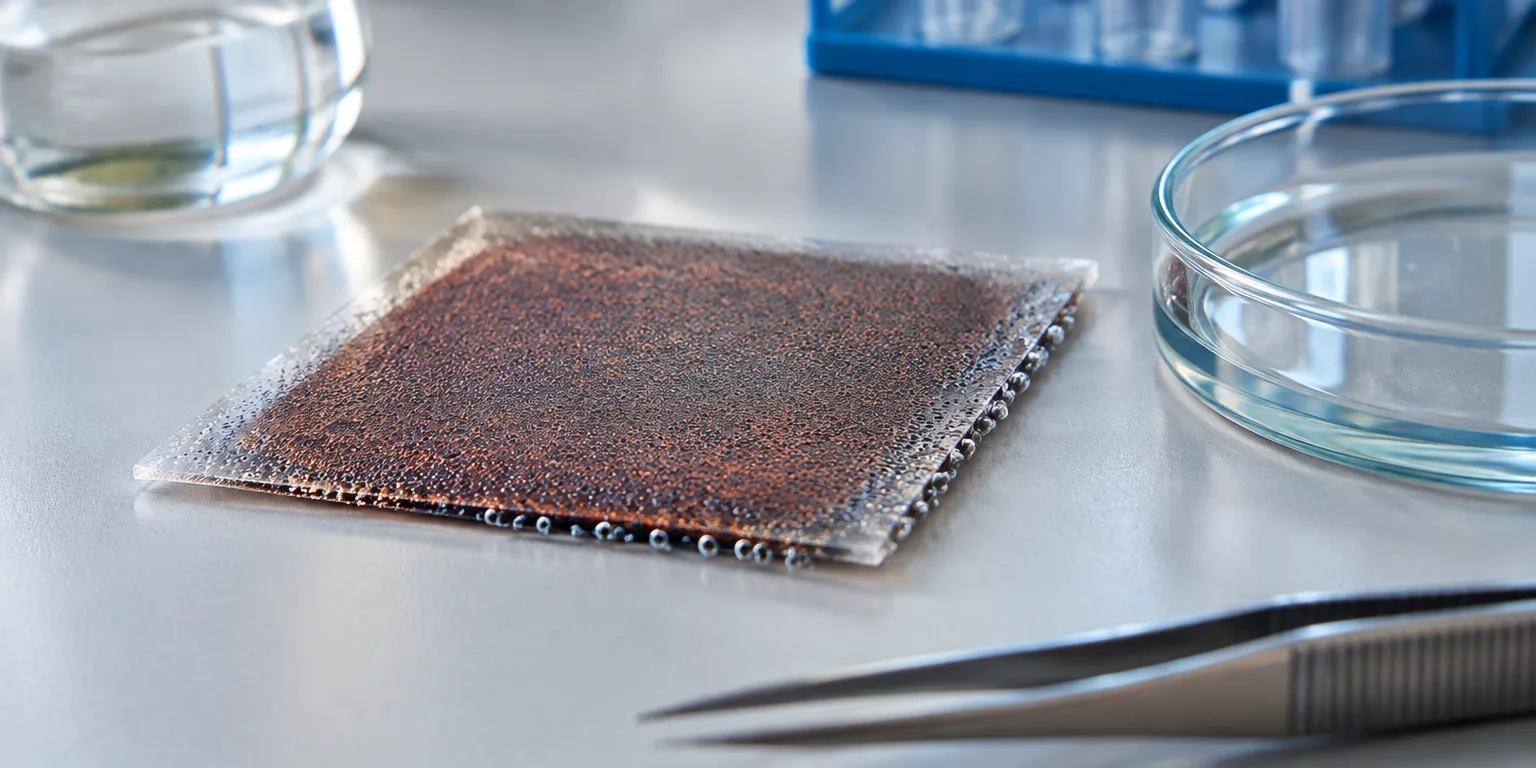
To improve delivery without changing the catalyst, the team wrapped a simple copper oxide catalyst in a porous, gas-loving skin. They replaced the PFSA ionomer, the standard fluorinated polymer binder used to hold the catalyst layer together, with mixed gas-loving binders and set the layer with mild heat to stabilize it.
Microscopy and spectroscopy showed close attachment between the polymer and the catalyst and a consolidated layer, the team reports. Computer modeling of gas and liquid flow linked better performance to more carbon dioxide at the surface and less flooding, not to a faster catalyst.
With the FEP/PTFE skin, ethylene output rose from 135 milliamps per square centimeter at 27 percent efficiency to more than 650 milliamps at 65 percent efficiency, compared with the same catalyst using the PFSA ionomer. The milliamp figure is a rate, or how much current from each patch of electrode goes into making ethylene, and efficiency is the share of electricity that ends up as ethylene.
That is about a fivefold gain in rate without changing the catalyst chemistry. The researchers describe such transport engineering as a potentially catalyst-agnostic way to improve gas-fed reactions run at high rates.
Questions people ask
Why try to make ethylene from carbon dioxide?
Ethylene is one of the most widely produced chemicals, mainly used to make plastics and other materials. Making it from waste carbon dioxide with clean electricity could both use emissions and displace fossil feedstocks, which is why it is a popular target for carbon-use technology.
What are FEP and PTFE?
FEP and PTFE are fluorinated plastics known for nonstick and water-repelling behavior. In this design they help keep gas passages open so carbon dioxide can keep reaching the catalyst, rather than carrying charged particles the way some other binders do.
Is this ready for industrial use?
Not yet. Laboratory electrode results show higher rate and selectivity, but industrial use would also require long operating life, large-area stacks, and low-cost clean power. The team presents the skin as a general transport strategy, but durability and scale-up remain to be proven.