A Deep-Sea Sponge Pairs Strength and Flow in One Lattice
Its glassy basket uses little material to stay rigid, while letting water pass without vibrating.
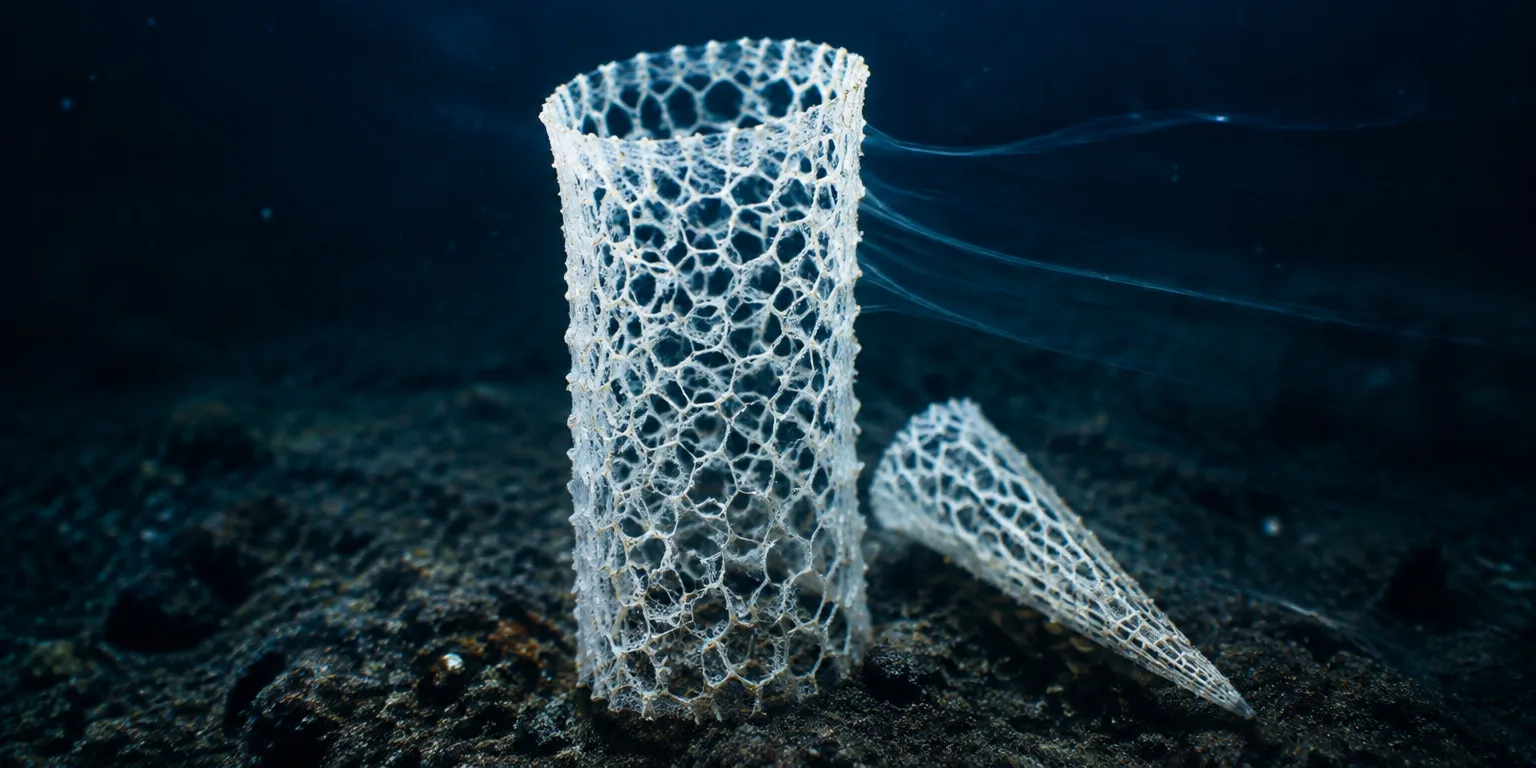
 engineering.berkeley.edu · When strength meets flow - Berkeley Engineering
Far below the ocean surface, deeper than 500 meters, lives Venus’ flower basket, a deep-sea glass sponge that often survives for millennia.
Its secret is its supportive frame, a detailed weave of glassy silica that stays strong while still bending.
A team spanning Berkeley and Harvard looked to that skeleton to design a new kind of engineered material. They wanted to optimize two requirements at the same time: structural resilience and fluid management.
Timon Meier, a graduate student involved in the work, said the aim was a light frame that "uses as little material as possible," yet remains stiff and supports heavy loads without breaking, while also avoiding vibrations and fluid loads.
To do that, the team developed a computer modeling system that tests both jobs together. One part, called finite element analysis, predicts where a design will bend or break. The other part, called computational fluid dynamics, simulates how fluid flows, swirls, and pushes against it.
The combined approach paid off. On average, the new lattice designs carried about 140 percent more load before buckling than randomly selected control structures. Buckling load means the force a structure can carry before it folds.
Even a small amount of openness helped with flow. Porosity as low as 5 percent significantly reduced vortex shedding, the alternating swirls that form behind an object, without compromising structural stability.
The result shows how strength and flow can be designed together rather than separately. Costas Grigoropoulos, a mechanical engineering professor, said, "This breakthrough could potentially help industrial manufacturers create new lightweight, high-performance materials in many application domains," for uses such as aircraft parts and biological structures.
Questions people ask
What is a metamaterial?
A metamaterial is an engineered structure whose behavior comes mostly from its shape, not just its chemistry. By arranging struts, holes, and curves in repeating patterns, designers can make something stiff, springy, soundproof, or fluid friendly, even from ordinary material.
Why does flowing water or air make structures vibrate?
When fluid moves past a solid, it can peel off in alternating swirls that push first one way and then the other. Those unsteady pushes can make bridges hum, pipes rattle, and antennas wobble. An open, porous shape lets some fluid through, which weakens the swirls and steadies the structure.
How can a skeleton made of glass be flexible?
Ordinary glass is brittle, so it tends to shatter rather than dent. As general context beyond this study, thin strands of glass can bend much farther than a thick pane before breaking, and a lattice shape can spread loads across many paths. The study itself describes the sponge skeleton only as a tough yet flexible silica structure.