A Small Siberian Collider Got a Different Answer After an Upgrade
The new count of particles from electron crashes disagrees with the old one, and physicists cannot tell which is right.
 Quanta Magazine · Physicists Solve a Big Quantum Mystery. Now, Old Results Don’t Add Up.
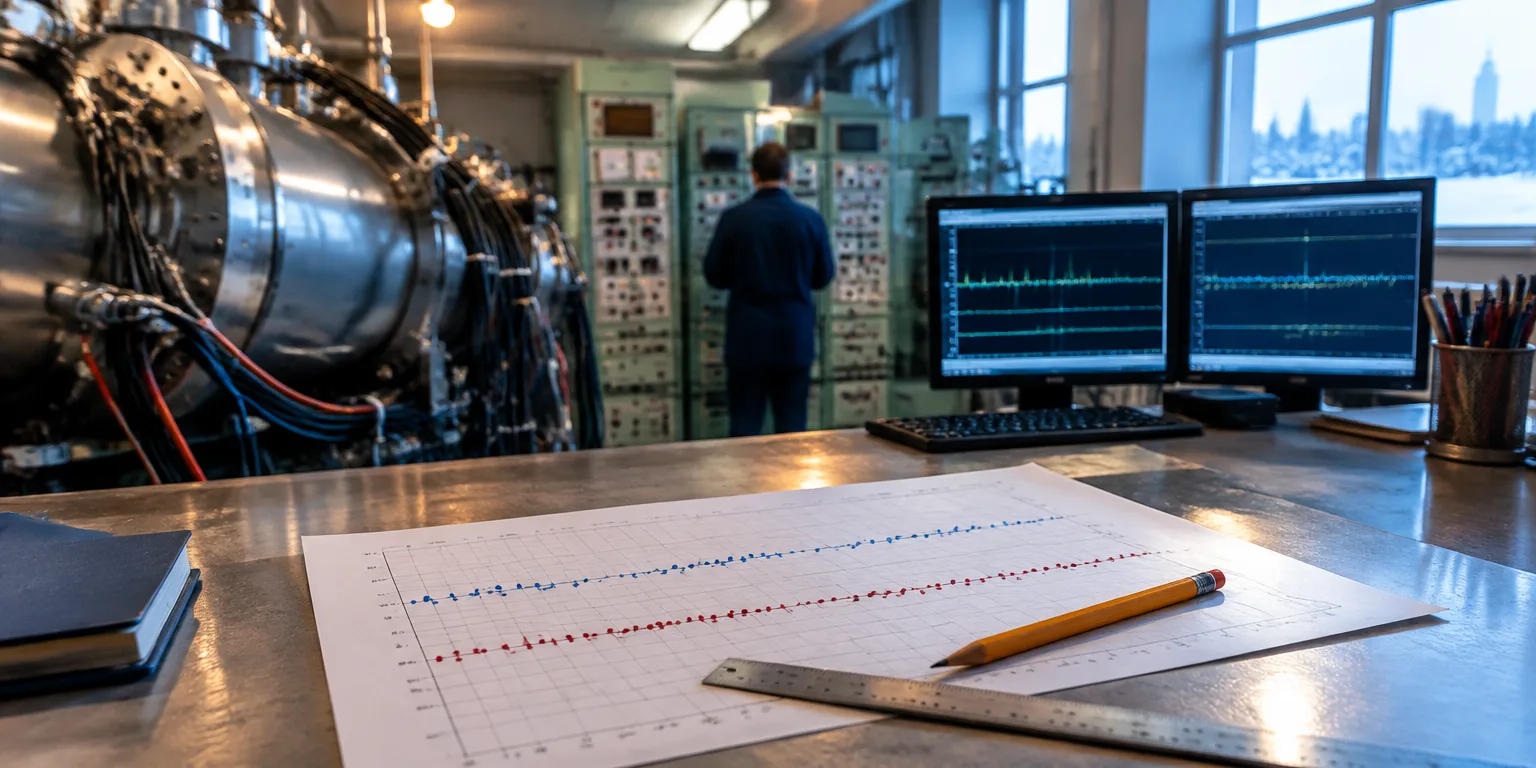
In Novosibirsk in southern Siberia, a modest machine has spent years crashing electrons into positrons, their antimatter counterparts. The collider, called VEPP-2000, works with roughly one six-thousandth the energy of the Large Hadron Collider near Geneva, and its work is careful counting rather than brute force.
On either side of the crash point sit detectors that tally how often the collisions produce pions, short-lived bundles of quarks. Physicists use that count to estimate how quark activity should shift the magnetic wobble of the muon, which is like a heavier version of the electron that behaves like a tiny bar magnet.
The trouble started after an upgrade. In 2010, the team installed a completely new detector and used it to remeasure the pion rate more precisely, publishing the result in 2023. The new rate was significantly different from what the same experiment had measured before.
That count feeds a calculation called the data-driven method, which predicts the muon's wobble from measured collider counts. That prediction falls short of the wobble measured at Fermilab in Illinois, while predictions made with lattice QCD match the Fermilab finding.
Lattice QCD is a calculation method that divides space into a grid and simulates the average behavior of quarks under the force that binds them. That lattice work includes a 2021 result from the BMW group, a collaboration of researchers in Budapest, Marseille, and Wuppertal, which matched the measurement, and other lattice groups have since agreed.
"It was a surprise. No one expected it to be like that," said Fedor Ignatov, a member of the Siberian team who works as a physicist at Liverpool University in Britain.
There had been faint hints of trouble. Measurements of the pion rate made in Italy and America had started to drift apart, but a sharp break with the Siberian experiment's own history was hard to ignore.
"No measurement has been scrutinized more," said Alex Keshavarzi, a researcher at University College London. Checks to date have revealed no flaws, recent grid-based simulations align with the new rate, and early results from the collider's other detector also seem to match.
Yet a 2023 analysis of earlier data from BABAR, a collider experiment in California, agrees strikingly with the older rate. Physicists are left unsure whether unknown particles are meddling with quarks, or an overlooked detail is creating the false impression that quarks are misbehaving.
"There are four decades of measurements that preceded that, that were all done in different ways, that were all done by different people, that were all done by different experiments, that all paint a completely different picture," Keshavarzi said. "There is so much still left to do."
Questions people ask
What is a pion, and why do physicists count them?
A pion is a short-lived particle made of quarks held together by the strong force. When electrons and positrons collide and annihilate, quarks can appear and quickly form pions. Counting how often that happens tells physicists how strongly quarks affect the muon.
What is lattice QCD?
Lattice QCD is a way to calculate the effects of the strong force with supercomputers. It divides space and time into a grid and simulates the average behavior of quarks and the particles that bind them. Because it does not use collider data, agreement with a pion measurement counts as independent support.
What happens next in the pion-rate puzzle?
Physicists want to pin down whether independent results cluster around the old Siberian number or the new one. If results from different teams pointed toward one rate, that would help separate a missed detail from the work of unknown particles.