To Waste Less Carbon, Run Dry and Wet Waste Side by Side
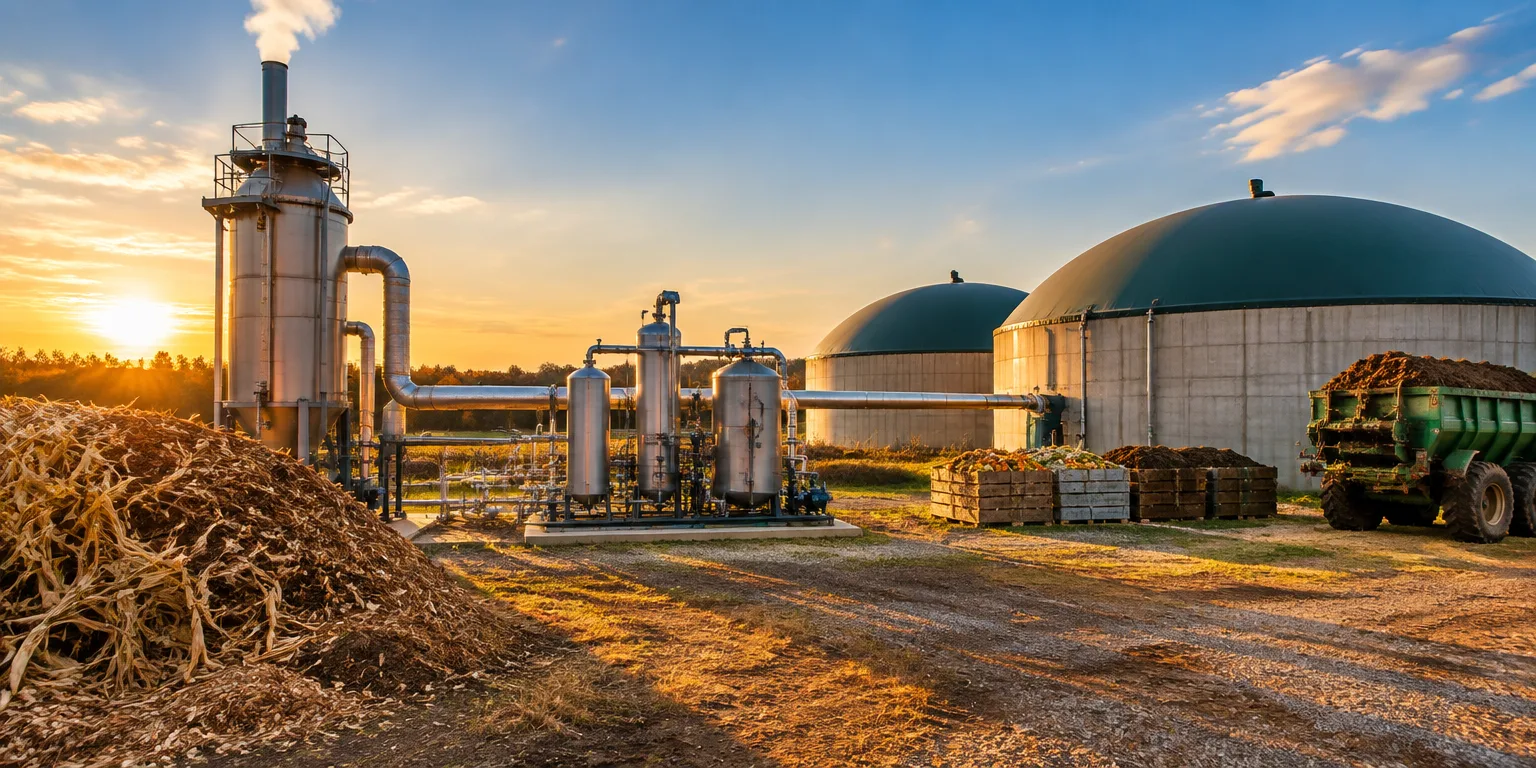
Dry biomass becomes syngas in a gasifier while wet waste becomes biogas for reforming, and the combined streams can feed fuel and chemical plants.
 pubs.acs.org · Biomass to Molecules:
Closing the Carbon Loop through
Integrated Thermochemical Conversion | JACS Au | ACS Publications
The authors frame biomass waste as a split: dry material suited to heat, and wet material suited to microbes.
Dry stalks and wood chips suit a gasifier, where high heat converts them into syngas. Soggy food scraps, manure, and sewage suit a digester, where microbes break them down without oxygen into biogas.
Their proposal, in plain terms, is to stop picking one route and run both side by side, then join the gases.
On the dry side, gasification, usually at 700 to 1,000 degrees Celsius, makes syngas, a mix of hydrogen, carbon monoxide, and carbon dioxide. That mix is a flexible starting material for methanol, diesel-like fuels, higher alcohols, and the building blocks of plastics.
On the wet side, anaerobic digestion makes biogas, mainly methane and carbon dioxide, with impurities such as hydrogen sulfide and moisture. Cleaned up, that biogas can become a methane-rich vehicle fuel, but the authors see a different job for it.
They argue that the methane-and-carbon-dioxide biogas should go through dry reforming, which reacts those two gases together into a second stream of syngas. That is not reforming the gasifier output itself, but making a companion syngas from wet waste.
Each stream is then conditioned to adjust its hydrogen-to-carbon-monoxide ratio for whatever comes next, and the two are combined. Because different end products want different ratios, that cleanup and tuning step is part of the idea, not an afterthought.
The payoff they claim is better use of carbon across crop leftovers, city trash, and factory wastes, turning a disposal problem into fuel and chemical production. Paired with carbon capture, they say, the system could move toward balancing its carbon books, or even removing more carbon than it emits.
They are clear about the catch: varied feedstocks, sticky tar, and fragile catalysts still limit scale-up. In particular, they argue, reforming catalysts proven on pure methane and carbon dioxide must next be tested on real, impurity-laden biogas.
Questions people ask
What is dry reforming, exactly?
Dry reforming reacts methane with carbon dioxide to make hydrogen and carbon monoxide, the two main parts of syngas. It is highly heat-hungry and usually runs around 700 to 900 degrees Celsius. Because it consumes two greenhouse gases at once, it is attractive when both are already present in biogas.
Why is tar such a problem in gasification?
Tar is a thick mix of condensable organic compounds formed when biomass is heated. It can condense and clog equipment, and block catalyst pores. Removing it by filtering or scrubbing can throw away carbon, so researchers prefer catalytic methods that convert tar into more syngas.
Could this combined syngas become aviation fuel?
Fischer-Tropsch synthesis can make diesel and jet fuel from syngas. Syngas with a lower hydrogen-to-carbon-monoxide ratio favors that route. The H2/CO ratio is tuned before that step to suit the desired product.