A Stone Box Can Hum and Tick Without Being a Machine
Trace uranium and natural resonance explain two of the Serapeum's strangest readings.
 The Why Files · Atlantis Left Its Technology in Egypt
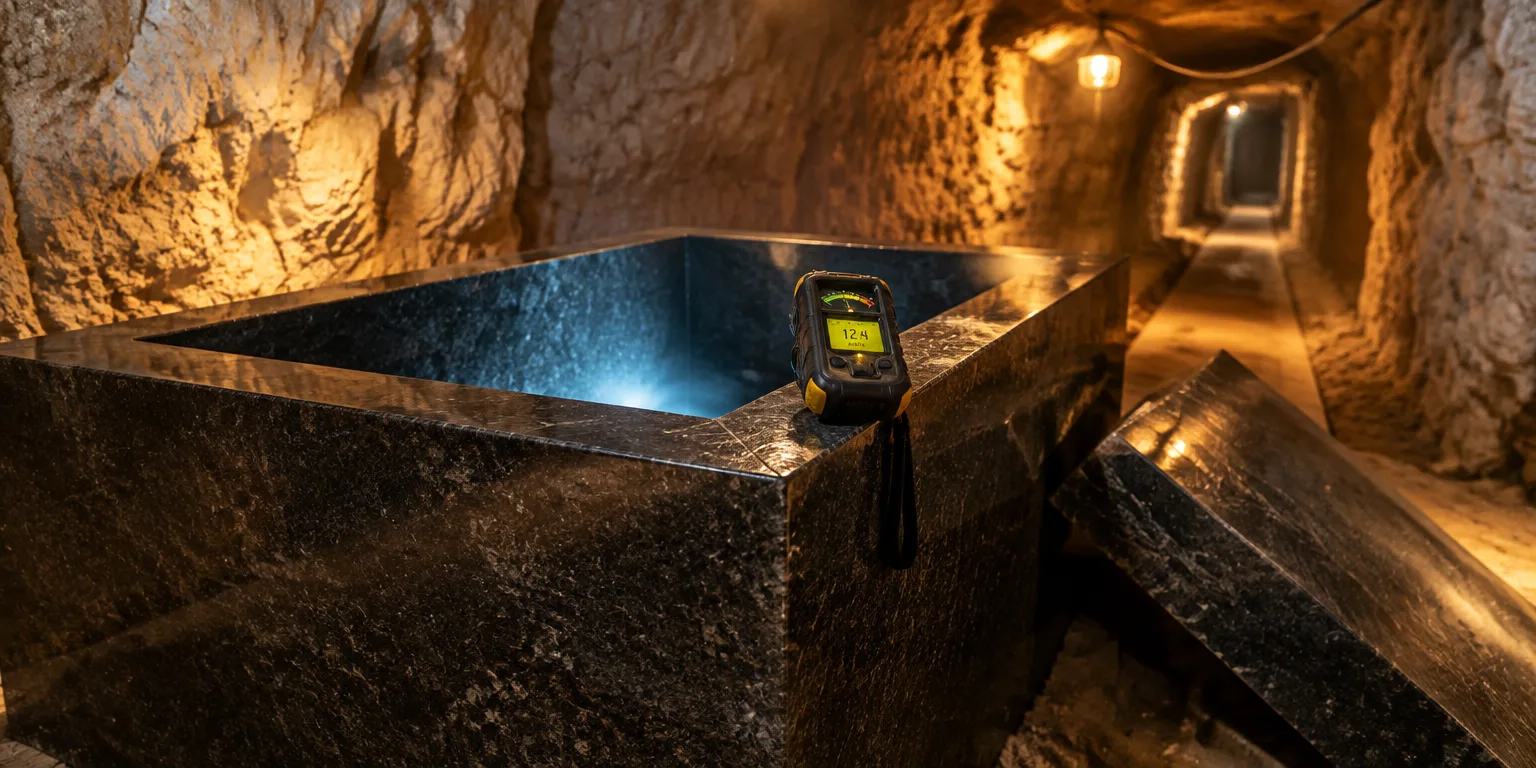
Step inside one of the giant granite boxes buried at Saqqara, and two strange things happen. A radiation detector clicks faster, and the stone holds a low, steady tone.
The boxes are 24 enormous granite containers set in a tunnel cut into limestone bedrock south of Cairo. Machine theorists point to a reading that rose from about 14 clicks a minute in the walkway to 38 clicks a minute inside a box, plus tones measured at 60 to 120 hertz.
The higher count starts with the stone itself. Granite naturally contains trace amounts of uranium, a heavy metal that slowly breaks down and releases radon, a colorless radioactive gas.
In an enclosed space, that gas has nowhere to go. It builds up inside a thick-walled box with a heavy lid, so a Geiger counter, a handheld device that clicks for each particle it detects, ticks more often inside than in the open tunnel.
The tone may come from the box's shape and smooth walls. A smooth stone enclosure that large tends to hum near 100 hertz, meaning 100 vibrations per second, a deep hum near the bottom of human hearing.
That fits the reported 60 to 120 hertz range. Like blowing across the top of a bottle, the cavity picks out one pitch, and hard, smooth walls keep the sound ringing longer.
The clicks and the hum have natural explanations in the stone and the shape of the room.
Questions people ask
Is 38 clicks a minute dangerous?
No. About 38 counts per minute is only modestly above background in many places, and handheld counters vary by device and setting. The important point is the pattern, higher inside an enclosed granite space, which is exactly what radon buildup would produce.
Can granite and stone rooms make radon at home, too?
Yes, in small amounts. Radon comes from uranium in soil and stone, and it can collect indoors. That is why health agencies recommend testing basements and ground-floor rooms, where air moves less, and venting the space if levels are high.
Why would a box that size hum so low?
Larger cavities favor lower pitches because longer sound waves fit more easily inside them. Hard, smooth walls also reflect sound well, so a large polished box sustains a deep tone around 100 hertz rather than a high ring.