Calling A Greek Bible Origen's Text Proves Nothing By Itself
The third-century scholar compared texts he already had, so agreement with him does not prove he created a reading.
 confessionalbibliology.com · Origen’s Hexapla and the Layered Greek Tradition - Confessional Bibliology
Chris Thomas, a writer on the Old Testament text, kept seeing the same shortcut in arguments about Greek Bibles. One writer called Codex Vaticanus, an old handwritten Bible in Greek, Origen's text. Another called a modern printed Septuagint, the Greek translation of the Old Testament, Origen's Septuagint. A third used Hexaplaric, a word for readings tied to Origen's six-column comparison of Bible texts, to mean little more than a Greek reading he distrusted.
Thomas answers with a sentence he treats as the test for everything that follows about the Hexapla, Origen's six-column comparison of Bible texts. "Origen's Hexapla demonstrates that Greek Scripture was already plural, revised, and critically compared; it does not prove that every later Greek Old Testament manuscript is a copy of Origen's fifth column."
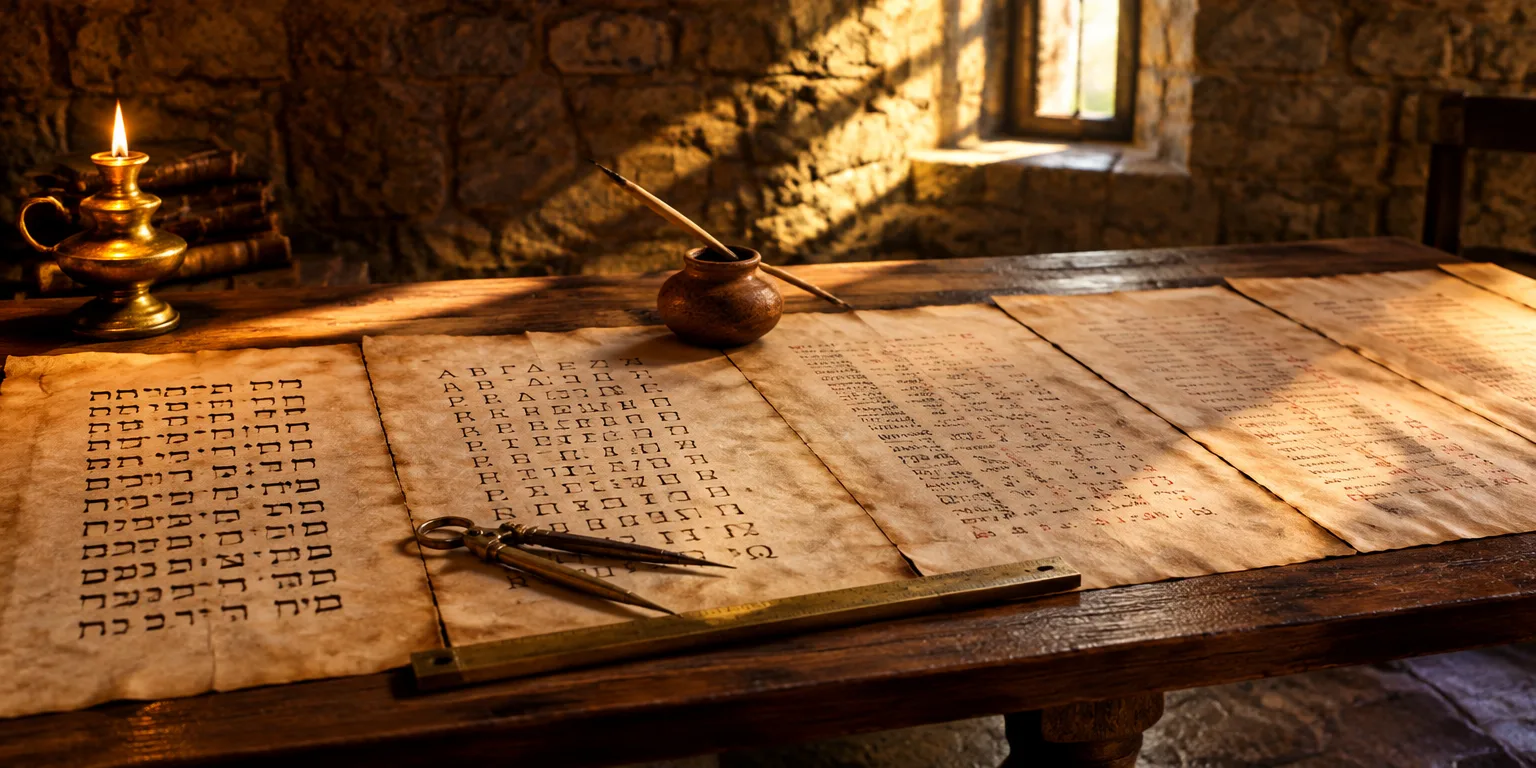
He means that Origen worked with variety rather than creating it from nothing. In the third century at Caesarea, Origen laid out six texts side by side: Hebrew, Hebrew written in Greek letters, three other Greek versions, and then, in the fifth column, the familiar Greek text with critical marks, alongside a sixth version.
That fifth column is where Thomas says confusion starts. Origen marked the Greek he received against the Hebrew he had, using an asterisk where he supplied words from another version and an obelus where the Greek had words with no counterpart in his Hebrew. Thomas argues the result was both an inherited text and an edited presentation, and those two layers must not be blurred.
So Thomas believes a sweeping label cannot settle a particular reading. He argues that to tie Vaticanus, or the whole surviving Greek tradition, to Origen, a critic would have to reconstruct the fifth column for the book in question, compare the reading, separate what Origen inherited from what he changed, rule out later revision and ordinary copying errors, and repeat the work book by book.
The same standard applies to claims of contamination. Later copies do sometimes mix early readings with Hexaplaric editing, and that mixture deserves investigation. Thomas writes that contamination is a relational term asking "contaminated with what, in which book, through which identifiable reading, and compared with which earlier form?" Since one manuscript can be early in one place and edited in another, a broad charge proves little.
Thomas concludes the evidence has to bear its own weight. Origen's work influenced some later Greek manuscripts but did not produce all of them.
Questions people ask
What is Codex Vaticanus and why do people argue about it?
Codex Vaticanus is a fourth-century manuscript of the Bible in Greek, held in the Vatican Library. Scholars value it because it is very old and nearly complete, and its Old and New Testament readings often figure in debates about which wording came first.
If the Hexapla is lost, what evidence is left of it?
No complete copy survives. Scholars reconstruct parts from fragments, notes in manuscript margins, quotations in early Christian writers, collections of commentary, and early translations made from Greek. Two examples are a seventh-century palimpsest with parts of Psalms and a tenth-century manuscript, but neither preserves the whole work.
Who were Aquila, Symmachus, and Theodotion?
Aquila, Symmachus, and Theodotion were translators who produced separate Greek versions of the Hebrew Scriptures. Origen set their versions beside the familiar Greek text so readers could compare differences in wording, additions, and omissions.