Engineer Reports Ancient Granite Box Is So Flat No Light Passes Under a Straightedge
Two engineers report perfect right angles and parallel walls, but no complete 3D laser scan has tested the claim.
 The Why Files · Atlantis Left Its Technology in Egypt
In a bedrock tunnel at Saqqara, 24 giant granite boxes have dark interiors that are highly polished and reflective, with no visible chisel marks, abrasions, or scratches.
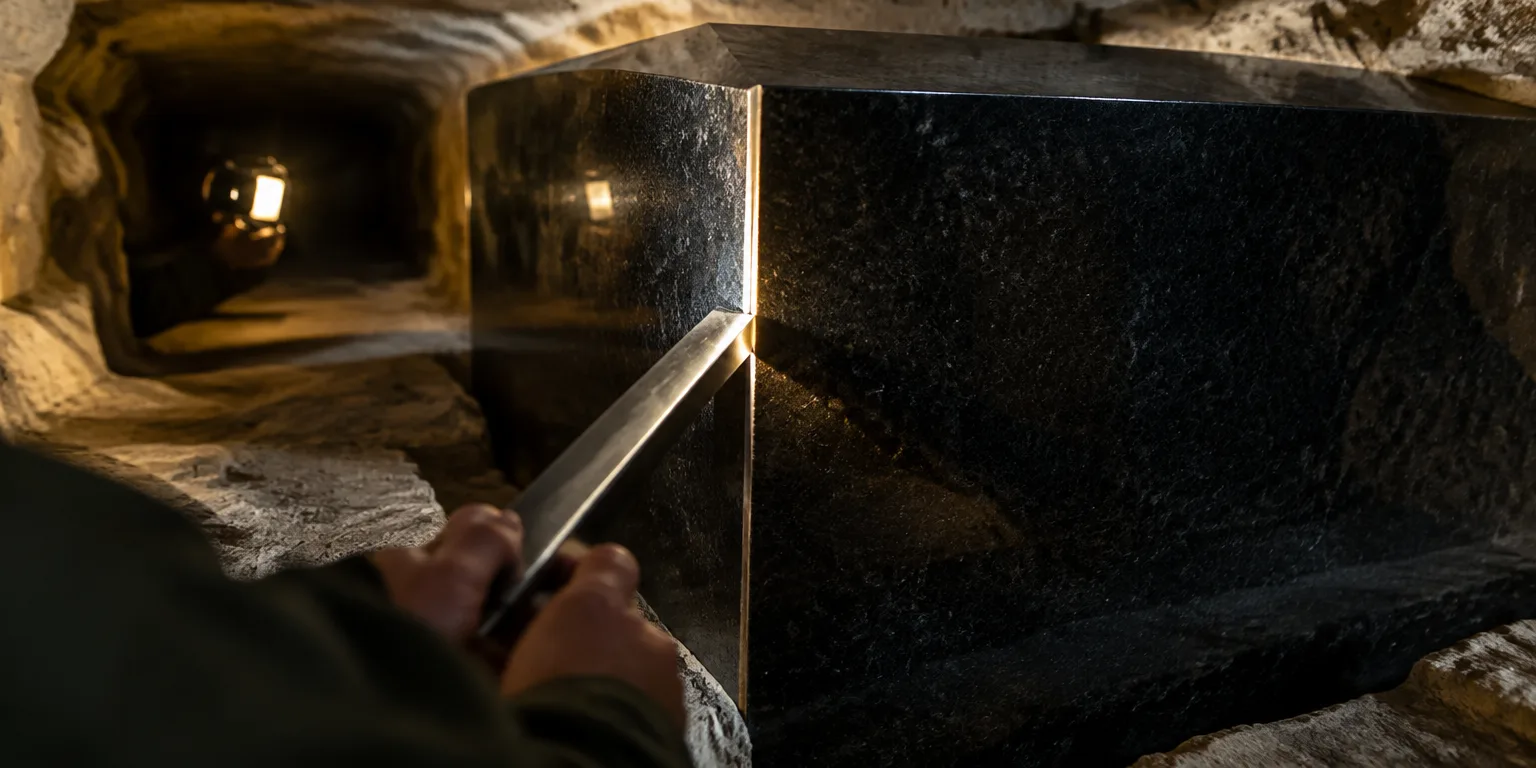
Aerospace engineer Christopher Dunn, who spent 40 years making jet engine parts, held a 12-inch steel straightedge to the stone and lit it from behind to look for gaps. He reported that no light passed underneath as he moved the blade across the face.
He reported inside corners that met the blade flush on both sides, forming perfect right angles, and opposite walls about five feet apart that ran exactly parallel. Four American firms that make ultra-flat granite tables told him they could not carve such a box from a single block.
Egyptian engineer Ahmed Adley later reported similar results with hand gauges, while skeptics propose pounding stones, copper saws, and wet quartz sand. No published 3D laser scan of all 24 boxes has settled the dispute.
Questions people ask
How does the straightedge and light test work?
You hold a straight steel edge against the surface and shine a light behind it. If there is a gap, light leaks through where the stone dips away from the blade. No light at that spot means there is no gap wide enough for light to get through there. The test cannot reveal gaps smaller than what that light and your eye can detect.
What would a full laser scan show that hand gauges do not?
A 3D laser scanner records millions of surface points and builds a precise digital model. Software can then measure flatness, squareness, and parallelism across the whole interior. It would replace spot checks with complete measurements for every box.
Could ancient workers grind granite flat without steel tools?
Granite is much harder than copper, so archaeologists generally propose stone pounders, abrasive sand, and long grinding rather than direct copper cutting. Experimental work has shaped granite with diorite pounders and quartz sand, though whether those methods can produce the reported flatness remains the disputed point.