Hotter Gasifiers Make Cleaner Gas, but Cost More to Run
Downdraft beds run cleaner than updraft beds, fluidized beds split the difference, and the hottest operation gives the cleanest gas.
 pubs.acs.org · Biomass to Molecules:
Closing the Carbon Loop through
Integrated Thermochemical Conversion | JACS Au | ACS Publications
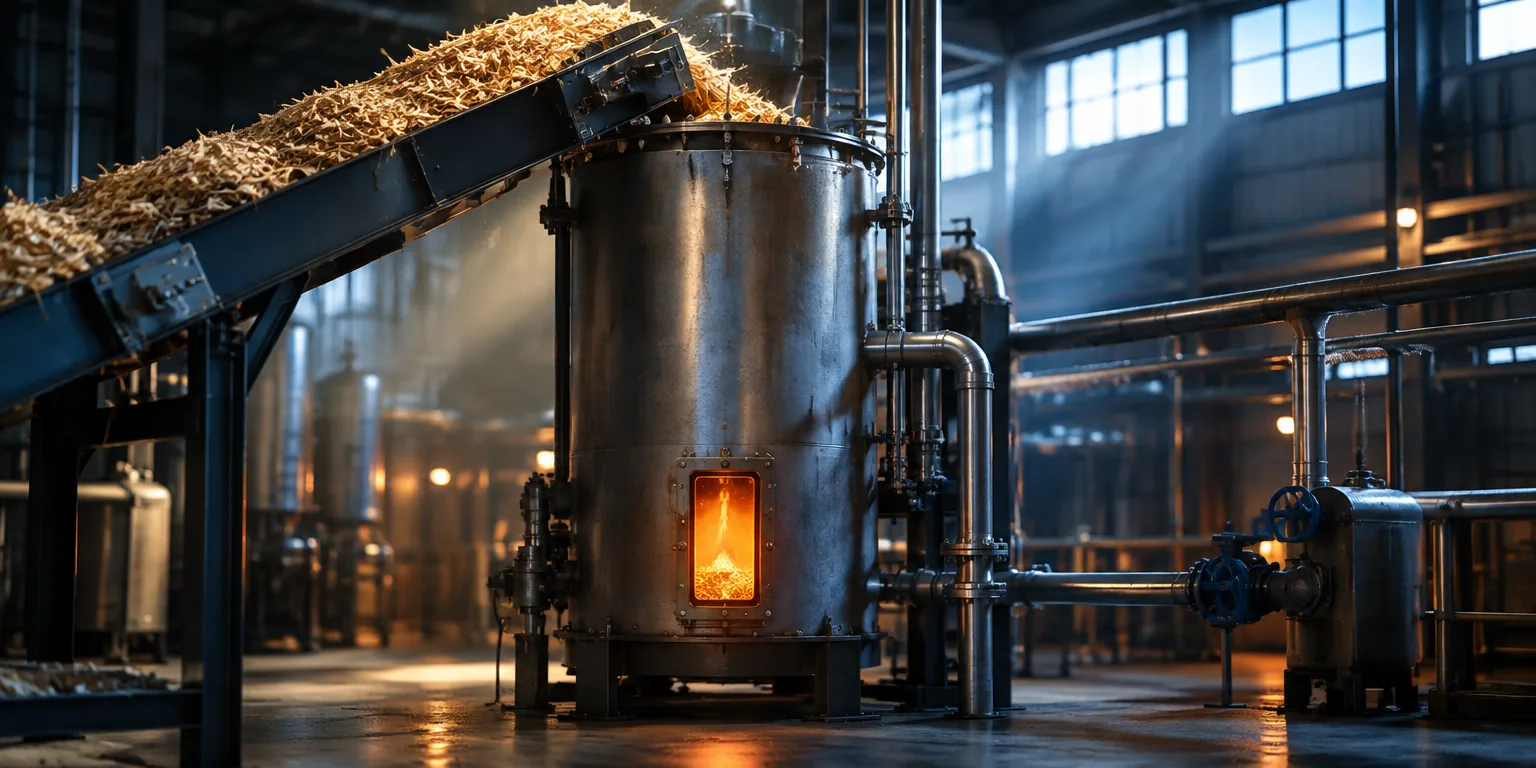
To turn wood chips, straw, and other dry plant waste into fuel, engineers do not burn it. They heat it with too little air for full combustion, making a mixture of carbon monoxide and hydrogen called syngas that can later become fuels and chemicals.
The simplest way to do that is a fixed bed. Biomass sits in a pile while air flows through it, a design that is cheap, rugged, and good for small systems but poor at spreading heat evenly and prone to leaving behind char, a charcoal-like leftover, and tar.
Direction matters inside that pile. In a downdraft unit, gases move down through the hottest zone, producing cleaner gas suited to small power generators. In an updraft unit, gases rise through cooler fuel, which saves heat but carries away much more tar, the sticky hydrocarbon vapors that later condense and clog pipes and catalysts.
The middle path is the fluidized bed, which bubbles air up through biomass mixed with hot, sandlike particles so the fuel floats and churns. That gives even temperatures, better mixing, and flexibility on moisture and particle size for medium-scale plants. The price is dusty gas, trickier operation, and still some tar.
The cleanest path is the entrained-flow gasifier. It blows fine, dry particles through a chamber at 1,200 to 1,500 degrees Celsius, converting nearly all the carbon into tar-free gas with little methane, ideal for chemical synthesis and hydrogen.
Higher temperatures make the cleaner gas. Higher temperatures speed the heat-absorbing reactions that make carbon monoxide and hydrogen, while cracking and reforming tar into useful gas. Slow heating and cooler operation do the opposite, letting fragments recombine on char into more tar and char.
But hotter is not free. Extreme heat wastes more energy, melts ash into slag, and can cause particles to stick and clump. Entrained-flow systems also demand large amounts of energy, costly construction, and dry, uniform feed.
Even good gas needs conditioning. Raw gas carries water vapor, particles, ammonia, hydrogen sulfide, hydrogen chloride, and trace minerals alongside tar. Removing tar by filtering alone throws away carbon, so one option is catalytic treatment that converts tar into more syngas instead.
Questions people ask
What exactly is tar in this context?
Tar is a mix of thick hydrocarbon vapors formed when plant matter does not fully break down. It cools into a sticky liquid or solid that blocks pipes, fouls filters, and coats catalysts, so gas must either be cleaned or the tar converted into more fuel gas.
What is syngas actually used to make?
Syngas is mainly carbon monoxide and hydrogen. After cleanup, it can be converted into methanol, diesel-like fuel, or hydrogen. The desired ratio of hydrogen to carbon monoxide depends on the final product.
If heat makes cleaner gas, why not always run as hot as possible?
Because heat has side effects. Very high temperatures increase heat loss, raise energy bills, and melt ash into slag that damages equipment. Operators therefore balance conversion and tar reduction against efficiency, ash behavior, and the composition they need downstream.


