Killer Whale Calls Show a Gap Where Leopard Seals Are Loud
The whales flatten their whistles inside the seals' pitch range, which suggests the flourishes carry the message.
 The Why Files · The Basement: Julia Mossbridge | The Future Is Sending Us Information, and Science Can Prove It
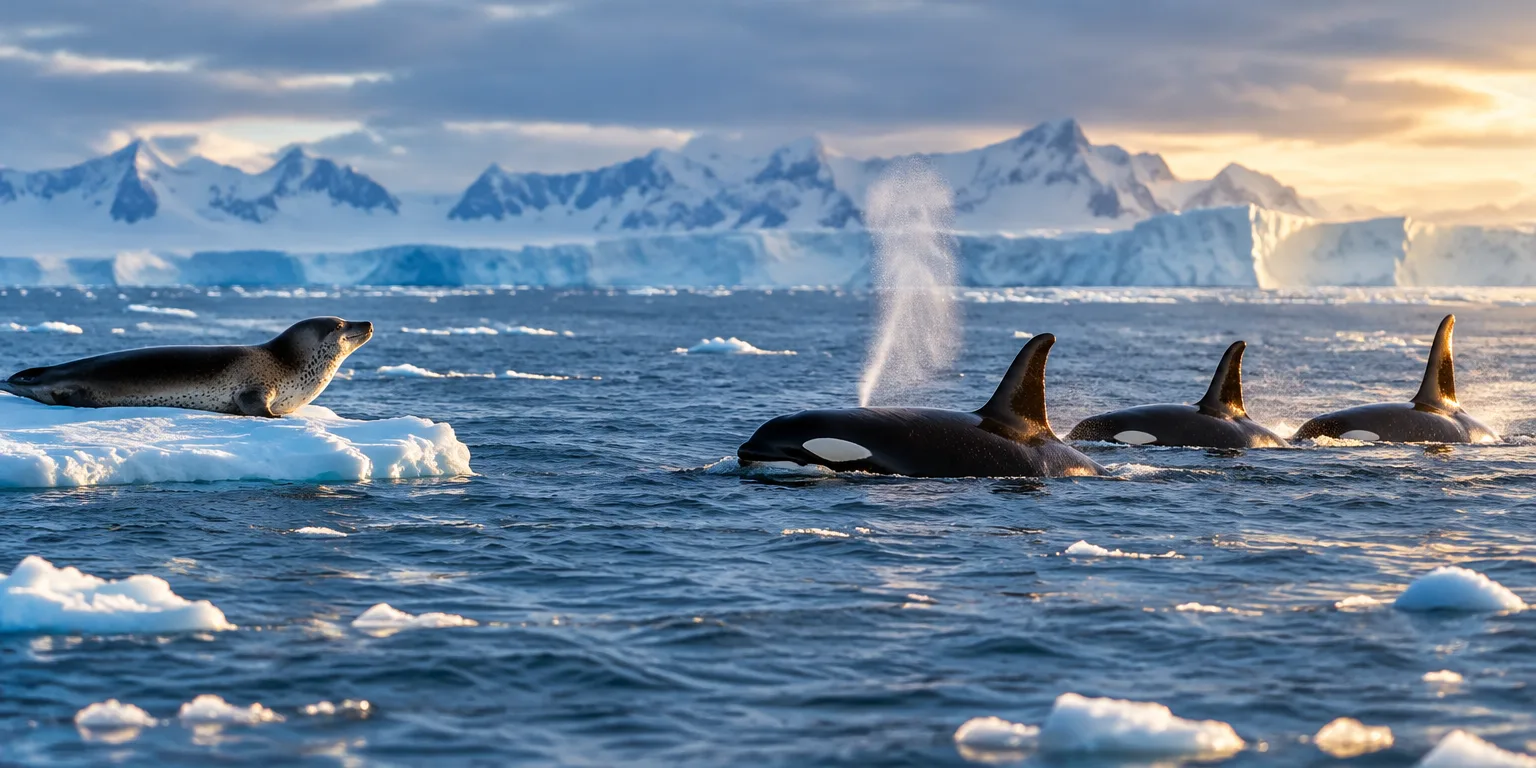
In the waters off Antarctica, killer whale calls appear to leave room for leopard seals. When the seals are vocalizing in one range of pitches, the whales avoid adding their own flourishes there, according to neuroscientist Julia Mossbridge, who analyzed recordings of both species.
She could see the pattern on a spectrogram, a chart that shows pitch rising and falling over time. Killer whale calls look like whistles and tweets, and the interesting part is the wiggle, the rapid rise and fall in pitch that scientists call frequency modulation.
Leopard seal calls are loud, groaning sounds that occupy a broad band of pitches. That band does not stay put. Between December and January, Mossbridge said, the seals shifted the range they used, and the whales shifted with them.
In one season, the whales would wiggle below the seal band, then flatten out as they crossed through it, then start wiggling again above it. In another season, when the seals had moved, the whales would wiggle freely in the range they had previously avoided.
To explain the gap, she compared it to talking at a noisy party with a humming air conditioner. People pick up on the pitch of the hum and will not do consonants in that range, she said. They just do vowels.
To Mossbridge, that suggests those little wiggles are meaningful, while a flat, unchanging pitch is like a vowel. Killer whales eat leopard seals, along with lots of small, shrimp-like prey, so she speculates the open channel may help them communicate with each other about food, such as where the seals or shrimp are.
Questions people ask
Do other animals change their calls to avoid background noise?
Yes. Many birds sing higher, louder, or at different times when traffic or other birds are noisy, and some frogs and insects shift their pitch to avoid overlap. Scientists call it avoiding acoustic interference, and it helps a signal stand out without using extra energy.
How do killer whales make whistles and clicks?
Killer whales do not whistle with their mouths. They push air through nasal passages below the blowhole, vibrating tissue there to make clicks, whistles, and pulsed calls. The sounds are focused and projected through fatty tissue in the forehead.
What are the small shrimp-like animals Antarctic whales eat?
Krill are small, shrimp-like crustaceans that gather in huge swarms in polar waters. They feed on tiny plankton and in turn feed whales, seals, penguins, and fish, making them a central link in the Antarctic food web.