Manatees Are Swimming Cousins of Elephants
Their grasping lips work like a tiny trunk, and their molars move forward on a lifelong conveyor belt.
 Stuff You Should Know · The World Needs More Manatees
Manatees come from the same ancient family line as elephants but stayed in the water, living along coasts and rivers rather than in the open sea.
Manatees belong to a lineage of sea cows that has been around for about 58 million years, and their bodies tell that story. Front legs became flippers, back legs fused into a broad, paddle-shaped tail, and the elephant trunk shrunk into a whiskered snout.
They never became fully ocean animals. Manatees are mammals that breathe air, and they can empty about 90 percent of their lungs with each exhale to take in fresh air. They mostly hug coasts, rivers, and estuaries where food grows in shallow water.
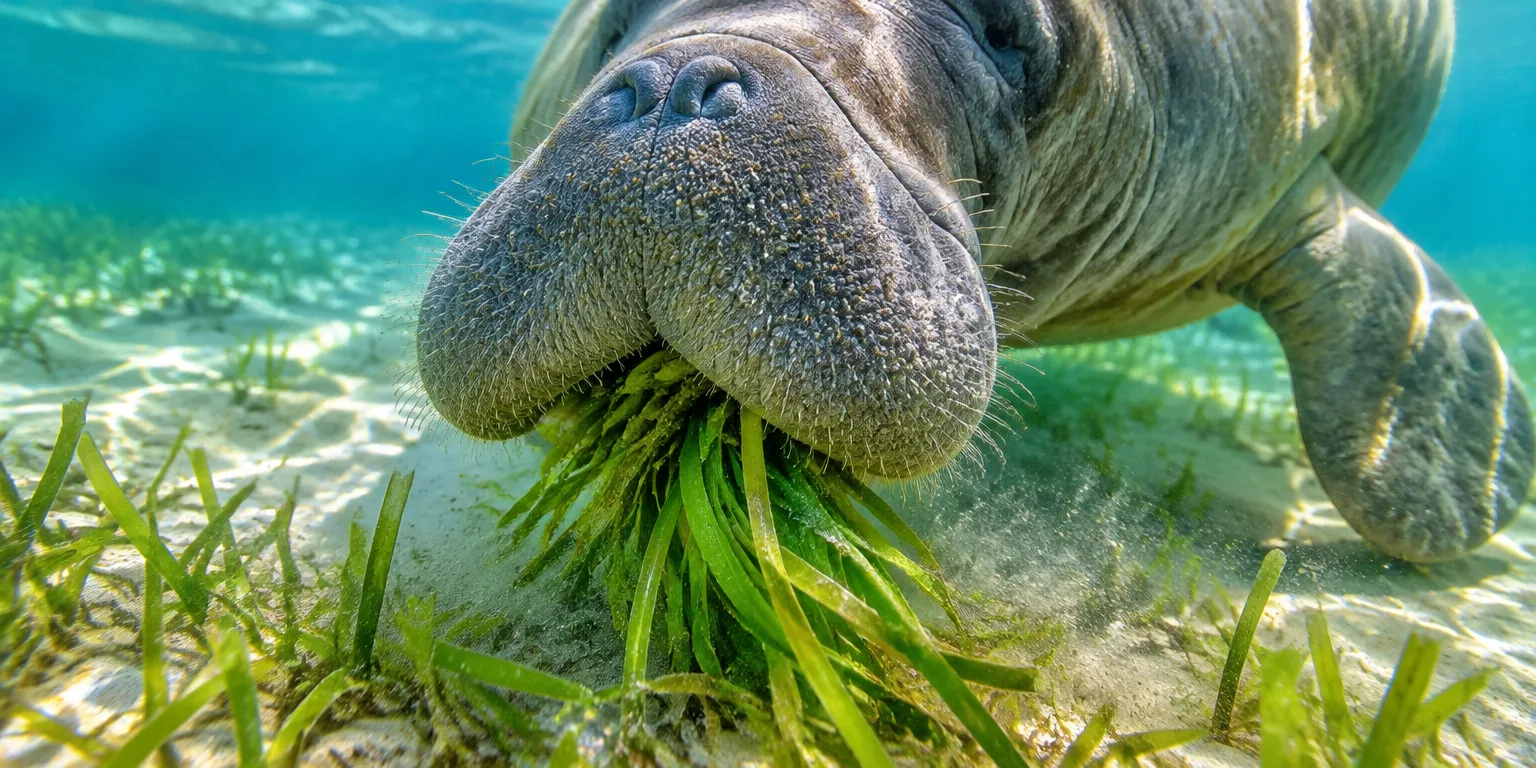
Look closely at the face and the family resemblance becomes clearer. Manatees have wrinkled, gray-brown skin with sparse hairs, small flippers, and prehensile, whiskered lips that work like two little hands.
Those lips grasp seagrass and eelgrass and pull it from the sandy bottom, much as an elephant trunk grabs leaves and grass. It is a precise tool on an otherwise bulky, slow-moving animal that usually cruises at three to six miles per hour.
That sandy diet explains their strangest elephant-like trait. Sand mixed in with seagrass constantly grinds down their molars, so worn teeth fall out and new molars emerge from behind to replace them throughout life.
The result is an animal built for endless grinding, with teeth that sit too far back to bite in an attack. That suits a life spent eating plants for hours each day.
Questions people ask
How big is a manatee?
Adults commonly weigh 800 to 1,200 pounds and measure about 10 feet long, although unusually large animals can be bigger. Newborn calves are about four feet long and weigh 60 to 70 pounds, and they can swim and vocalize soon after birth.
How much do manatees eat?
Manatees may spend about eight hours a day eating and can consume as much as 10 percent of their body weight in vegetation. Their slow metabolism suits warm water but makes it harder to stay warm in the cold.
Why do Florida manatees gather in winter?
They have little insulation and no blubber, so prolonged exposure to water below about 68 degrees Fahrenheit can be dangerous. In winter, Florida manatees gather at natural springs around 72 degrees and sometimes near warm-water outflows from power plants.