AI Can Separate Effort From Finished Work, and Learning Is at Stake
Teachers graded the essay, but the work to write it was where learning happened. Now machines can skip the work.
 The Journal. · The High Schools Going All-In on AI
In Tallinn, Estonia's capital, Wall Street Journal reporter Sam Schechner toured a state high school known as PERG with its principal, Indrek Lillemagi. Lillemagi uses AI tools himself, including vibe coding, but his school does not require any student to use AI.
Lillemagi told Schechner that students use AI anyway, and he does not believe giving them school accounts "pushes them to use it more." His worry is unsupervised use, and what happens when students hand the work to the machine.
That worry led Schechner to his larger point about school. As he put it, "AI basically breaks the connection between effort and output."
Under the old setup, teachers asked students to answer questions or write essays and judged the finished work. The effort to produce that work was the point, because that effort was the learning.
AI can now produce the finished work without that effort. Schechner notes the tools can do high school assignments and pull together many texts into summaries, and as he put it, "reading something long and figuring out what's important and what it's connected to, that's thinking, too."
Those thinking skills are what school is meant to teach. He describes school as a gym for the brain, where a personal trainer can show what weights to lift and in what order, but if the student does not lift them, the student does not get stronger.
If learning comes from the effort itself, Schechner argues, grades for polished output stop making sense. As he put it, "you have to rethink your whole pedagogy because if the point is the effort, then the grade or the output kinda don't really matter anymore."
Estonia is trying one partial answer in its national AI Leap experiment, starting with tenth and eleventh graders. In a program run with OpenAI and Google, those students get their own school ChatGPT accounts.
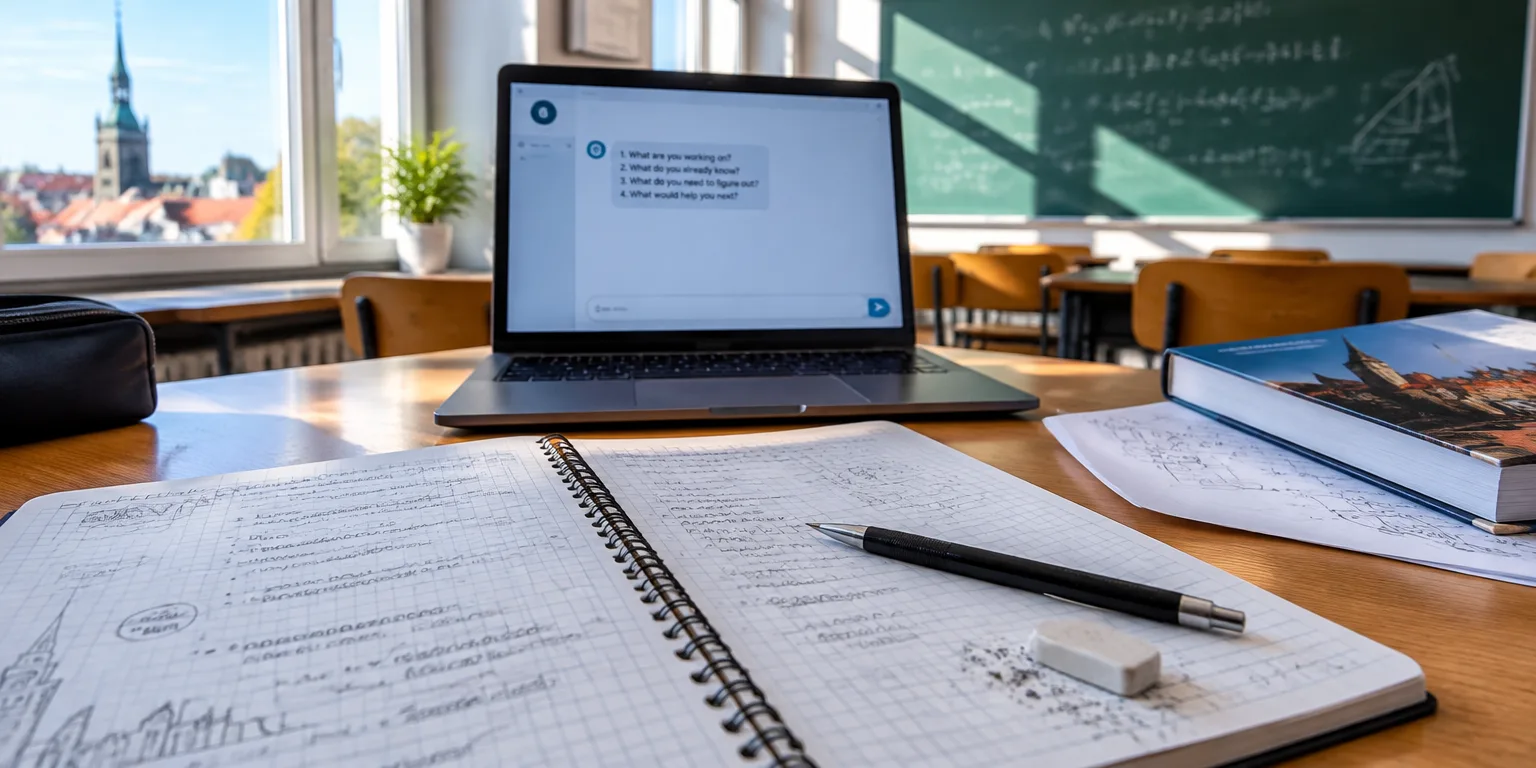
The school version includes a Socratic chatbot that will not answer homework questions directly, but helps students plan how to approach an assignment, more like a tutor than an answer machine.
Questions people ask
How would judging effort actually work?
Schechner does not lay out a full new grading system. His argument is that teachers have to rethink their approach so that effort counts more than the polished finished product. Estonia's try is a tutoring chatbot that asks guiding questions and helps plan work instead of supplying answers.
What is Estonia's AI Leap?
It is a national experiment starting with tenth and eleventh graders, who get their own school ChatGPT accounts in a program run with OpenAI and Google. It began after a 2024 survey found 90% of the country's high school students were already using generative AI for learning.