The Scientist Said 75% Claimed More Than His Models Could Back Up
He said a neat probability implied a precision his models could not back up.
 Washington Examiner · An inconvenient fact-check of Al Gore’s Inconvenient Truth on its 20th anniversary
In 2006, former Vice President Al Gore offered moviegoers a strikingly precise forecast about the far north.
He cited research professor Wieslaw Maslowski, who studies polar ice with computer models, and called the numbers new. “These figures are fresh,” Gore said.
Then came the figure itself: “Some of the models suggest to Dr. Maslowski that there is a 75% chance that the entire north polar ice cap, during the summer months, could be completely ice-free within five to seven years.”
Maslowski, the scientist whose modeling was being described, questioned how that number had been reached.
“It’s unclear to me how this figure was arrived at,” he said at the time.
Then he stated his own rule for talking about an uncertain Arctic future. “I would never try to estimate likelihood at anything as exact as this.”
Maslowski’s point was about false precision. Models could explore what might happen to summer ice, he believed, but turning that exploration into 75% within five to seven years claimed more certainty than his work could support.
A recent commentary marking the film’s 20th anniversary points to northern ice accumulation and record Antarctic accumulation from 2021 to 2023. That is only a two-year stretch, too brief by itself to establish the longer direction of summer ice, so it does not by itself prove or disprove a longer-range forecast.
Questions people ask
Did the Arctic actually become ice free in summer?
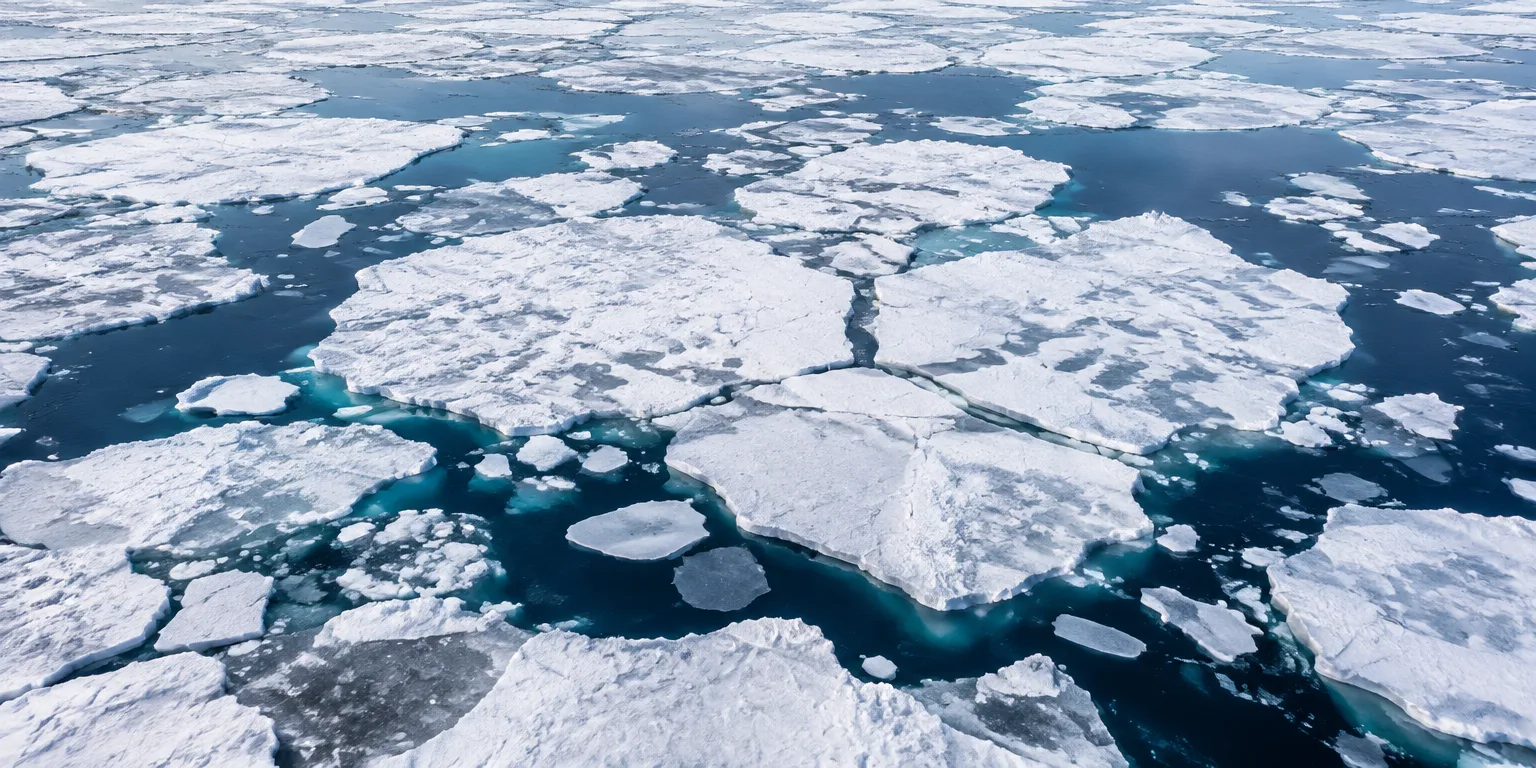
No. Arctic sea ice still shrinks every September and regrows every winter. The summer minimum has declined over recent decades, to roughly 4 to 5 million square kilometers in recent years, but satellites still observe several million square kilometers of ice each summer.
What do scientists mean by an ice free Arctic?
Scientists generally use ice free to mean less than one million square kilometers of ice remaining, not literally zero. A small amount of thick ice usually lingers near northern Canada and Greenland even in a very low year. So the term describes a largely open Arctic Ocean.
Why avoid an exact number like 75%?
Because sea ice depends on temperature, wind, ocean heat, and natural ups and downs, as well as longer trends. Different models make different assumptions, so researchers often speak in ranges and scenarios rather than single odds. Maslowski's point was that 75% sounded more certain than the science allowed.