Mount Rushmore Hides a Titanium Vault Behind Lincoln's Head
Borglum believed future generations might find the monument as mysterious as Stonehenge.
 The Why Files: Operation Podcast · America Is Hiding Something Underground (Compilation)
There is an unfinished hall behind Abraham Lincoln's head at Mount Rushmore, and it holds a titanium vault of American history sealed behind 1,200 pounds of granite.
The monument began as a 1924 tourism proposal by historian Don Robinson, who wanted a grand carving to draw travelers to South Dakota. Sculptor Gutzon Borglum, hired to create the four 60-foot faces, believed future people might find Rushmore as mysterious as Stonehenge.
His answer was the Hall of Records, a room 80 feet high and 100 feet long reached by an 800-foot granite staircase. It was to hold busts of famous Americans, the Declaration of Independence, the Constitution, and the Bill of Rights, beneath a bronze eagle whose wings would have spanned 38 feet.
Work began in July 1938 but stopped about a year later, leaving only a 70-foot hollow cut into the rock. In 1998, the government approved a more modest version of the idea. Today, porcelain enamel panels explain the carving, the four presidents, and Borglum himself, alongside the texts of the Declaration of Independence, the Constitution, the Gettysburg Address, and the Bill of Rights.
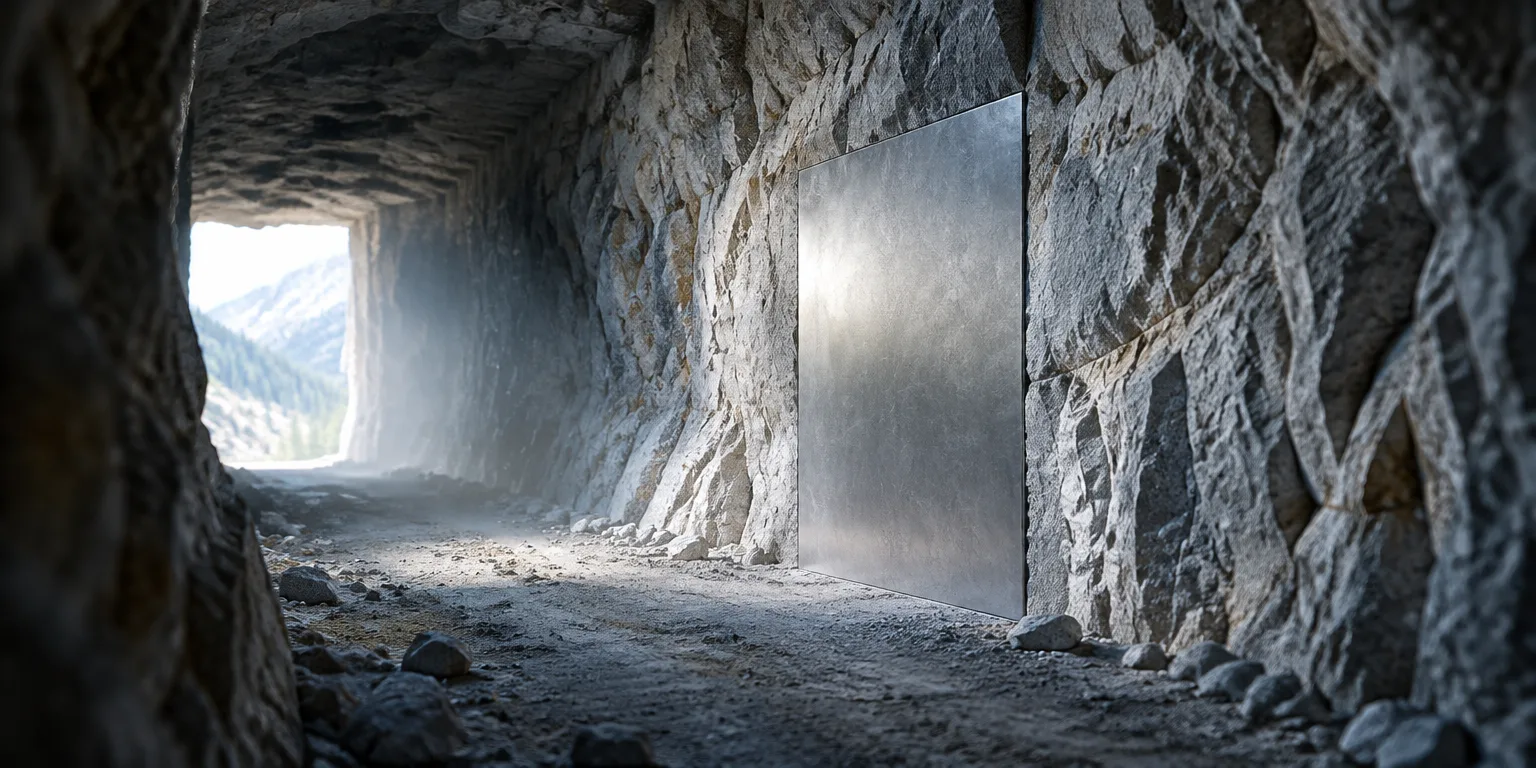
The panels sit in a titanium vault behind the granite slab. It is not open to the public.
Questions people ask
Can visitors see the Hall of Records?
No. The chamber sits in the rock behind Lincoln's hairline and is closed to the public. Visitors to the memorial can see the mountain face and museum exhibits, but not the vault itself.
Why did Borglum want a hall inside a mountain?
He wanted to preserve the story of why and how Rushmore was carved, along with core American documents. The idea was to leave a durable record for people far in the future, even if other records were lost.
What exactly is inside the titanium vault?
Porcelain enamel panels describe the history of Mount Rushmore, why Washington, Jefferson, Roosevelt, and Lincoln were chosen, and include a biography of Borglum. Other panels carry the texts of the Constitution, Bill of Rights, Declaration of Independence, and Gettysburg Address.