Police Use Polygraphs for the Talk, Not the Test
Courts generally bar polygraph results, but what a suspect says during the questioning around the test can still be used.
 Bear Brook · A Private Matter, Episode 5
In April 2024, Lieutenant Dana Flanders, a New Hampshire police officer, set up a polygraph to question Patty Hickey about her missing husband Jay in a small conference room at the Epsom police station.
Flanders, then with the nearby town of Loudon and described by Jason Moon, who covered the case, as "brought in as a kind of closer," told Patty he prided himself on eliciting truthful information. He said he was so confident that he thought he could tell when someone was lying without a polygraph.
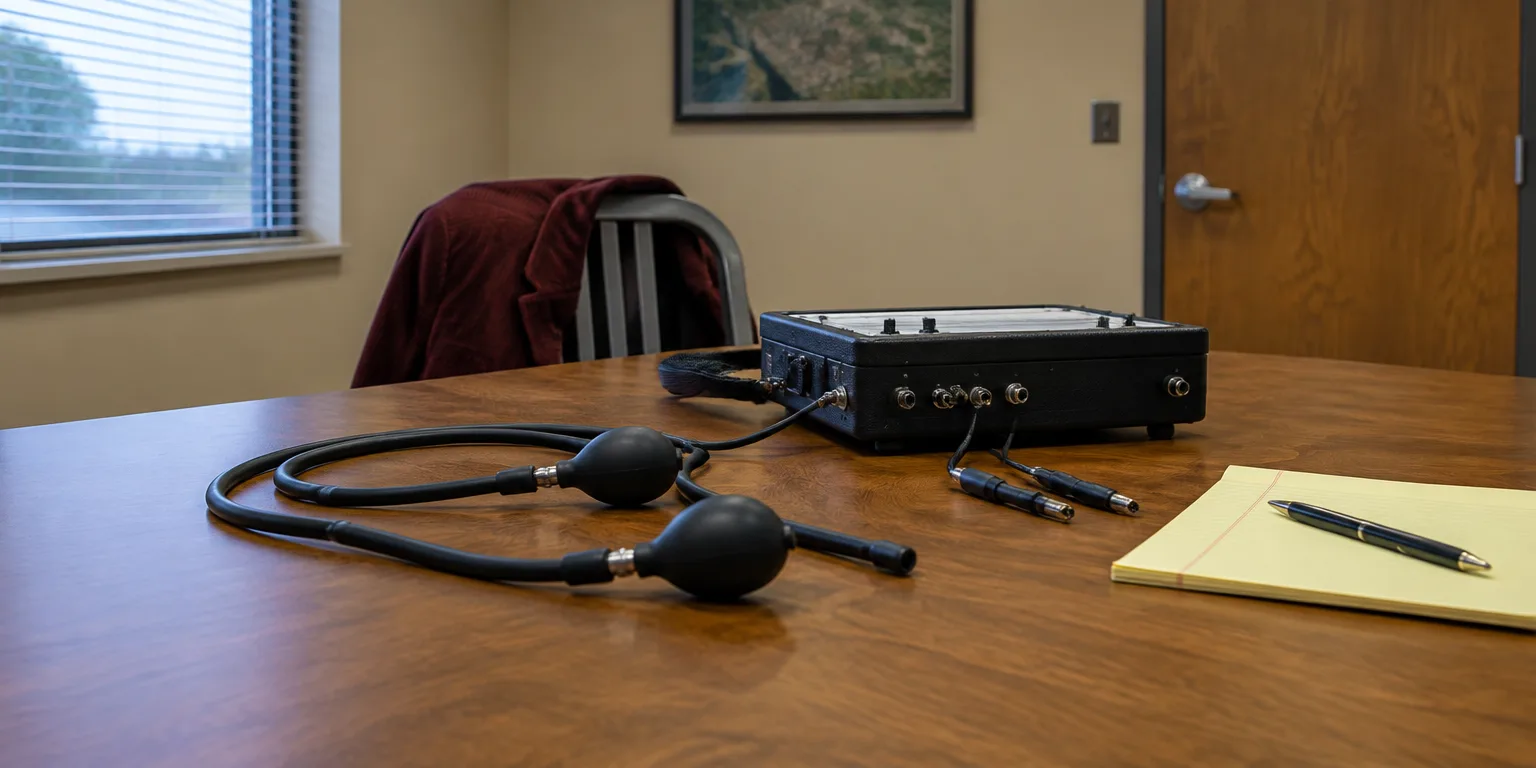
Patty, dressed in jeans and a dark red corduroy top, asked if she needed to remove the shirt. Flanders said no, invited her to come look at the equipment, and pointed out two black pneumograph tubes, explaining that one goes below the heart and one goes above it.
The setup looks scientific, but Moon points to decades of research suggesting polygraphs are not reliable. In one study of cases where people were later cleared by DNA tests, polygraphs gave an incorrect result in a majority of those cases.
Most courts, including New Hampshire's, generally don't allow polygraph results as evidence because the results are seen as unreliable.
Moon offers a possible explanation, suggesting the attraction may be what happens next. Moon says, "while the polygraph exam isn't admissible, what you say in the interrogation that comes after it often is."
Flanders put his own view bluntly, saying the only proof he ever needed from polygraphs came from exams that ended with a confession. In Patty's case, he never even attached the tubes.
In his report, Lieutenant Dana Flanders wrote, "I did not believe Hickey was suitable for testing due to her own mental status and potential memory issues," without elaborating further. He then continued the interrogation in what he called a more confrontational way, and the tubes stayed unattached while the questioning went ahead.
Questions people ask
What does a polygraph actually measure?
A polygraph usually records breathing, pulse, and sweating while an examiner asks yes-or-no questions. The problem is that nervousness, fear, anger, medical conditions, and effort can move those signals, so courts have concluded the results are too unreliable to prove truth or lying.
Can police make you take a polygraph?
No. In the United States, you can generally refuse a polygraph, and refusing cannot by itself prove guilt. Officers may ask and may use agreement as a way to keep a long interview going, but you have the right to decline and to ask for a lawyer.
Why would words said near a polygraph count when the test does not?
Judges look at whether a statement was voluntary and whether warnings and rights were properly given. A confession or admission made freely during questioning can be admitted even if the polygraph chart itself cannot, which is why investigators focus on getting a clear, recorded account.